UNESCO: IT’S PURPOSE & PHILOSOPHY
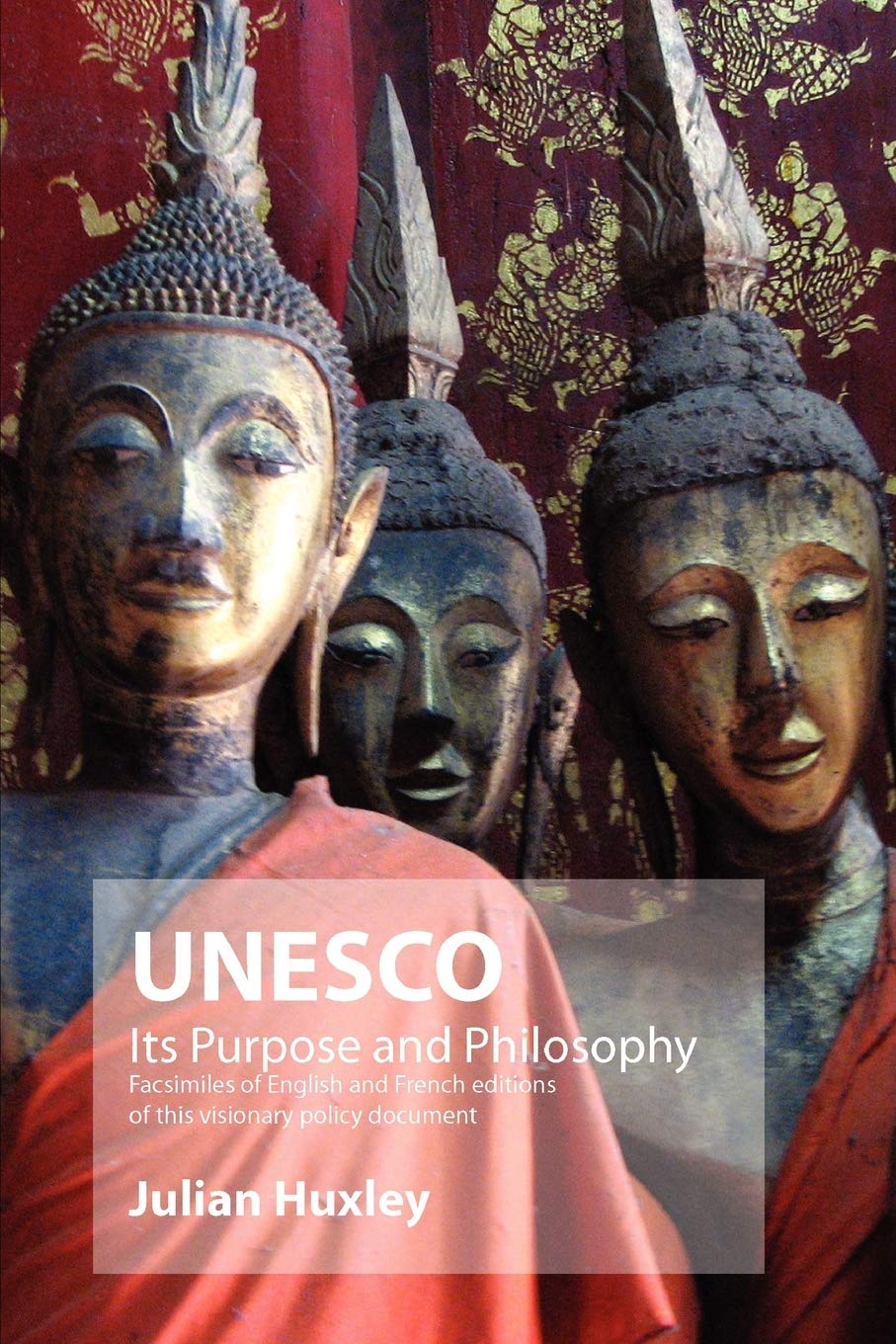
AUTHOR – JULIAN HUXLEY
GENRE – Geopolitics
YEAR PUBLISHED – 2010 (Original 1946)
PAGE COUNT – 146
READABILITY – Easy
MY RATING – 4.1/5
What to expect?
- Why an One world govt is needed?
- How to achieve world peace?
- Is any form of soft eugenics required?
- Control of population, reforming education & promoting such an ideal.
The Dawn of Scientific World Humanism
Julian Huxley’s 1946 document, “UNESCO: Its Purpose & Its Philosophy” serves as a foundational text for the United Nations Educational, Scientific & Cultural Organisation yet it reads as a highly ambitious manifesto for the top down management of the human race. As the agency’s first Director General, Huxley explicitly rejects traditional religious dogmas & static political doctrines, proposing instead that UNESCO adopt a working philosophy of “scientific world humanism, global in extent & evolutionary in background”. Under this framework, humanity is viewed not through the lens of individual liberty but as biological raw material that must be carefully managed to ensure evolutionary progress. Huxley argues that man is the sole trustee of further evolutionary advancement on this planet, making it UNESCO’s ultimate destiny to realize maximum progress in the minimum amount of time. To achieve this, he outlines a radical vision of the future that heavily relies on global political unification, population control & soft eugenics.
The Push for a One World Government
Despite UNESCO’s stated focus on education, science & culture, Huxley bluntly asserts that these tools alone are fundamentally inadequate to secure lasting global peace. He argues that the evolutionary key to human advance is a unified, common pool of tradition & ideas which is currently obstructed by the existence of separate, sovereign nations. Consequently, he declares that UNESCO must envisage some form of world political unity, potentially culminating in a single world government as the only certain means of avoiding war. While he acknowledges that world political unity is a remote ideal that falls outside UNESCO’s immediate legal competence, he insists that the organization must actively pave the way for it. Huxley suggests that UNESCO should use its educational programs to familiarize the global public with the implications of transferring full sovereignty away from separate nations & handing it over to a world organization. By unifying the world in the “things of the mind” through international enterprises, he believes UNESCO can lay the psychological groundwork necessary for the eventual dissolution of national borders.
Eugenics & the Management of Biological Inequality
Perhaps the most chilling aspect of Huxley’s philosophy is his clinical approach to human genetics & biological inequality. He argues that the democratic principle of equality of opportunity must be drastically amended to account for the bedrock scientific fact that human beings are genetically unequal. Huxley notes that individuals differ vastly in desirable qualities such as physical strength, general intelligence & mathematical or musical aptitude & he insists that these differences are biologically rooted. From this premise, he issues a warning about the genetic future of humanity, asserting that the indirect effect of modern civilization is currently dysgenic rather than eugenic. Because society protects its weakest members, he fears a dead weight of genetic stupidity, physical weakness, mental instability & disease proneness is accumulating within the human species, threatening to crush any hope of real evolutionary progress.
To combat this, Huxley advocates for the implementation of eugenics, arguing that humanity’s innate mental powers could & should be improved through deliberate eugenic measures. He states that the primary aim of eugenics must be the raising of the mean level of all desirable qualities across the population. While he concedes that radical eugenic policies are currently politically & psychologically impossible, he outlines a clear, long term strategy for UNESCO: the organization must carefully examine the eugenic problem & relentlessly educate the public mind so that “much that now is unthinkable may at least become thinkable”. He insists that eugenics must be brought entirely within the borders of science, preparing society for a future where improving the average quality of human beings becomes an urgent, globally managed necessity.
Overpopulation & the Planned Control of Humanity
Closely tied to his views on eugenics is Huxley’s anxiety regarding global overpopulation. He warns that mankind’s blind reproductive urges possess the capacity to completely wreck human ideals & plans for material & spiritual betterment. For human evolution to be properly steered, Huxley argues that society must recognize the concept of an “optimum population size”. This recognition is an indispensable first step towards the planned control of populations. He even cautions that the blind application of science can be socially disastrous; for e.g, utilizing medical science merely to increase the number of human beings in a given area without raising their quality of life is, according to his evolutionary criteria, fundamentally wrong. Therefore, he mandates that UNESCO must balance its policies regarding medical & agricultural advancements with social welfare initiatives that explicitly include the widespread provision of birth control facilities.
The Restrictive Limits of Higher Education
Huxley’s belief in strict biological inequality also heavily colors his views on global education. While UNESCO is tasked with fighting illiteracy, Huxley is careful to point out that mass education has hard genetic limits. He bluntly asserts that it is a disagreeable fact of nature that a considerable percentage of the population is simply not capable of profiting from higher education. He criticizes educational systems that view higher education as a universal right, arguing that allowing the genetically ungifted to attempt university studies is a complete waste of their youth, the time of their teachers, & public money. As equality of educational opportunity increases, Huxley notes that this biological reality will only become more obvious. He therefore tasks UNESCO with encouraging the accurate study of the distribution of intelligence so that educational systems can be heavily stratified, ensuring that resources are concentrated on training the genetically gifted elite to become the leaders, administrators & high grade technicians of the future.
Mass Media, Propaganda & the “Mass Creed”
To implement this massive restructuring of human society, Huxley outlines a strategy for total cultural & psychological persuasion. He views modern mass media like the press, the radio & the cinema as revolutionary tools that must be harnessed to build a global consensus. Preaching peace is not enough instead UNESCO must formulate a positive mass philosophy & a mass creed. Huxley argues that the techniques of persuasion, information & true propaganda that nations learned to apply during wartime must now be deliberately bent to the international tasks of peace. In a strikingly authoritarian moment, he quotes Lenin to suggest that these propaganda techniques must be utilized to “overcome the resistance of millions” to desirable change. By orchestrating art, documentary films & global broadcasting, the scientific elite can effectively mobilize society for action, transforming Huxley’s evolutionary humanism from an academic theory into the overriding psychological reality of the modern world.