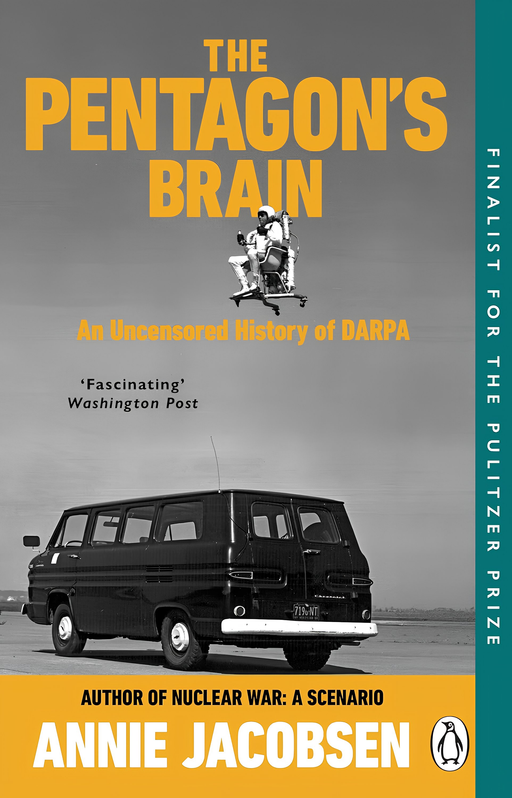
AUTHOR – ANNIE JACOBSEN
GENRE – History & Science
YEAR PUBLISHED – 2015
PAGE COUNT – 560
READABILITY – Easy
MY RATING – 4.7/5
What to expect?
- First Hydrogen Bomb testing
- US-USSR Cold war
- Vietnam War strategies & technologies
- Gulf & Iraqi War strategies & technologies
- Drone Technology
- What’s the future with advanced AI warfare?
The Genesis of Advanced Warfare: Hydrogen Bombs, Wars & Scientific Weaponry
The history of modern military dominance is rooted in a continuous cycle of scientific surprise, political paranoia & the pursuit of a qualitative technological edge. This cycle manifested starkly on March 1, 1954 during the Castle Bravo thermonuclear test on Bikini Atoll. Achieving a catastrophic 15 megaton yield (250 percent more powerful than calculated), the blast became the worst radiological disaster in human history, demonstrating a terrifying capability to exterminate entire civilian populations with radioactive fallout. Despite being deemed an “evil thing” by Manhattan Project pioneers like Enrico Fermi & Isidor Rabi, the drive for absolute supremacy fuelled an unyielding defense research infrastructure. To maintain this edge, the United States turned to the dark expertise of Operation Paperclip, a secret intelligence program that imported Nazi scientists & engineers (including Wernher von Braun & Georg Rickhey) to construct deep underground command centers like the Raven Rock Mountain Complex (Site R) to ensure governmental continuity during a nuclear strike.
To analytically manage these apocalyptic stakes, the Pentagon relied heavily on the RAND Corporation, its first postwar think tank. At RAND, defense intellectuals used game theory, mathematical abstractions & specialized war games like Kriegspiel to map out strategic nuclear doctrines such as mutual assured destruction (MAD) & second strike capability. This highly clinical environment eventually birthed the Jason scientists, an elite secretive cabal of theoretical physicists & mathematicians funded by the Advanced Research Projects Agency (ARPA). The Jasons were tasked with solving seemingly intractable national security dilemmas through bold, untethered scientific conceptualization.
When the United States slipped into the quagmire of the Vietnam War, ARPA & the Jasons shifted their focus from continental nuclear deterrence to unconventional counterinsurgency (COIN) warfare. Through Project Agile & the Combat Development & Test Center (CDTC) in Saigon, ARPA tested an array of “techniques & gadgets,” including the lightweight AR-15 assault rifle, silent sailplanes & canine chemical tracking systems. Most controversially, this era saw the implementation of the Jason’s “Anti Infiltration Barrier” (the electronic fence or Igloo White) which used air dropped seismic & acoustic sensors to map communist movements along the Ho Chi Minh Trail. This was accompanied by a brutal, large scale defoliation & anticrop campaign that sprayed millions of gallons of toxic herbicides, such as Agent Orange, directly onto the Vietnamese jungle.
Decades later, the templates established in Vietnam were heavily re engineered for the Iraq War. The initial 1991 invasion showcased DARPA’s “system of systems” which is a synchronized, network centric warfare matrix utilizing stealth aircraft, precision laser guided munitions, real time JSTARS airborne tracking & satellite based Global Positioning Systems (GPS) to swiftly decimate conventional Iraqi forces. However, the post 2003 occupation plunged the military into a bloody, asymmetric urban theater dominated by improvised explosive devices (IEDs).
Advanced Drone Weapons
The weaponization of unmanned assets has evolved from crude, remote controlled platforms into a pervasive global network of airborne, terrestrial & maritime drone systems. DARPA’s pioneering work in this field began during the Vietnam War with audio stealth gliders & the subsequent development of mini drones like Praerie & Calere, which utilized early television cameras & forward looking infrared (FLIR) to direct precision laser guided munitions at night. The agency also deployed unmanned helicopter systems, such as the Nite Panther, to transmit real time visual intelligence back to mobile ground stations.
In the 21st century, this concept expanded into Micro Air Vehicles (MAVs) designed to mimic the natural world. Biomimetic drones engineered to look like birds, hummingbirds & dragonflies are utilized to blend seamlessly into urban environments for clandestine surveillance. Going a step further, DARPA’s biohybrid programs actively couple organic insects with machines by surgically implanting microprocessors & electrodes into green June beetles & the pupa stage of Manduca sexta moths. These insect cyborgs allow operators to remotely control their brain & wing functions, enabling them to fly inside buildings & track human targets undetected. For broader geopolitical reach, DARPA has pushed into the hypersonic realm with the Falcon HTV-2, an armed drone capable of traveling at Mach 20 to strike any global target in under an hour, alongside the XS-1 space drone & the Hydra undersea mother ship, which can covertly deploy both aerial & submersible baby drones from maritime depths.
Advanced Artificial Intelligence
Modern artificial intelligence is built upon a continuous military effort to conquer cognitive complexity & achieve real time strategic calculation. The lineage traces directly back to mathematician John von Neumann’s work on early computers like ENIAC & MANIAC, culminating in his final, prophetic manuscript, The Computer & the Brain, which posited that computers would eventually outperform the human nervous system & learn to think. DARPA leveraged this architecture through the SAGE air defense network & the subsequent conceptualization of “Man Computer Symbiosis” by J. C. R. Licklider, who envisioned an integrated, multi user “Intergalactic Computer Network” (the ARPANET) where machines would graduate from passive data collectors to active intellectual partners & mentors.
This drive for computational dominance reached its zenith with supercomputers like ILLIAC IV, which introduced parallel processing to handle the massive data requirements of ballistic missile defense & real-time radar filtering. Following the terror attacks of 9/11, DARPA attempted to weaponize this raw processing power on a domestic scale through John Poindexter’s Total Information Awareness (TIA) program. Utilizing advanced software like Genoa II & Evidence Extraction algorithms, TIA was engineered to achieve “cognitive amplification,” allowing AI systems to seamlessly scour, filter & analyze massive public & private databases simultaneously. By tracking the minute digital signatures of millions of citizens in real time, the system was designed to bypass human cognitive biases & autonomously predict, flag & intercept asymmetric threats before they materialized.
CyberHuman Super Soldiers & Future Warfare
As the boundaries of information technology, nanotechnology & biology began to converge at the turn of the century, DARPA established the Defense Sciences Office (DSO) to systematically address the biological limitations of the human asset. Under the philosophy of transhumanism, the agency stopped viewing the human body as a fixed, immutable biological given & instead treated it as an adaptable mechanism that could be technologically re engineered. The direct application of nanobiotechnology allowed military scientists to begin coupling electronic microprocessors directly with living tissue, seeking to control evolution on the battlefield. By aggressively investing in frontier biotechnology, the DSO sought to eliminate the fundamental physical, physiological & cognitive boundaries that had historically left infantry forces vulnerable to fatigue, panic & physical degradation during prolonged combat operations.
The ultimate realization of DARPA’s transhumanist & autonomous research is the systematic eradication of human frailty from the battle space, replacing or augmenting the organic soldier with cybernetic systems. On the front, this began with General Paul Gorman’s “SuperTroop” powered exoskeleton concept, an armored, climate controlled suit designed to amplify human strength, shield the operator from ballistic or chemical threats & embed a personalized computer profile directly into the soldier’s gear. To supplement this mechanical frame, the DSO initiated the Persistence in Combat program, which successfully researched pain vaccines designed to instantly neutralize the inflammatory response of a gunshot wound for thirty days, alongside magnetic, wand activated micro particles to instantly freeze internal bleeding. Furthermore, through the Continually Assisted Performance initiative, scientists utilized sleep-deprivation drugs like Modafinil & studied the neurological mechanics of dolphins to engineer a “24/7 soldier” capable of operating at peak cognitive capacity for seven consecutive days without sleep, while exploring biochemical compounds like hydrogen sulfide to induce a temporary state of protective hibernation in critically wounded troops.
This internal re engineering is crowned by the Brain Machine Interface program, which successfully tested the implantation of wireless modems directly into the cerebral cortexes of animals to teleoperate their motor movements, with the ultimate military objective of allowing human warfighters to communicate, plan & activate weapons systems by thought alone.
Concurrently, the battlefield is being heavily populated by autonomous killer robots that operate entirely outside of real time human control. Guided by Department of Defense Directive, DARPA has transitioned weapons systems from human operated platforms to fully self directed machines that translate high level strategic goals into lethal tasks without human interaction. This automated army includes the legged AlphaDog & the ultra fast Cheetah robot, alongside heavily armed tracked platforms like the MAARS (Modular Advanced Armed Robotic System) & the Talon SWORD, which are equipped with motion detectors, acoustic sensors & machine guns to detect, track & execute human targets from miles away. Working in unison with swarming, autonomous Micro Air Vehicles programmed to covertly enter buildings & detonate explosive or chemical payloads on targeted individuals, these self optimizing, self healing machine networks represent a terrifying paradigm shift where the cold, calculated execution of warfare is completely yielded to artificial systems.
Conclusion
A historical review of the Defense Advanced Research Projects Agency reveals an institution that has successfully functioned as the primary architect of the future, consistently forcing the boundaries of known science to preserve global military dominance. From the atomic panic of the Cold War to the invisible data dragnets of the war on terror, the agency has systematically engineered human frailty, geographic distance & architectural barriers out of the strategic equation. Yet, the legacy of this permanent, high tech war footing is deeply fraught with existential peril. By pioneering full machine autonomy, genetic manipulation & total information awareness, the military industrial complex has birthed a reality where technologies of total control & automated destruction operate far ahead of public comprehension or moral consensus. Ultimately, the trajectory of this advanced weaponry poses a dark ultimatum for the 21st century: humanity must either find a way to ethically harness these terrifying revolutions in science or face an impending era defined by automated slaughter, permanent electronic surveillance & the absolute tyranny of self governing machines. I would highly recommend this to get an overview of the past/present/future warfare technologies