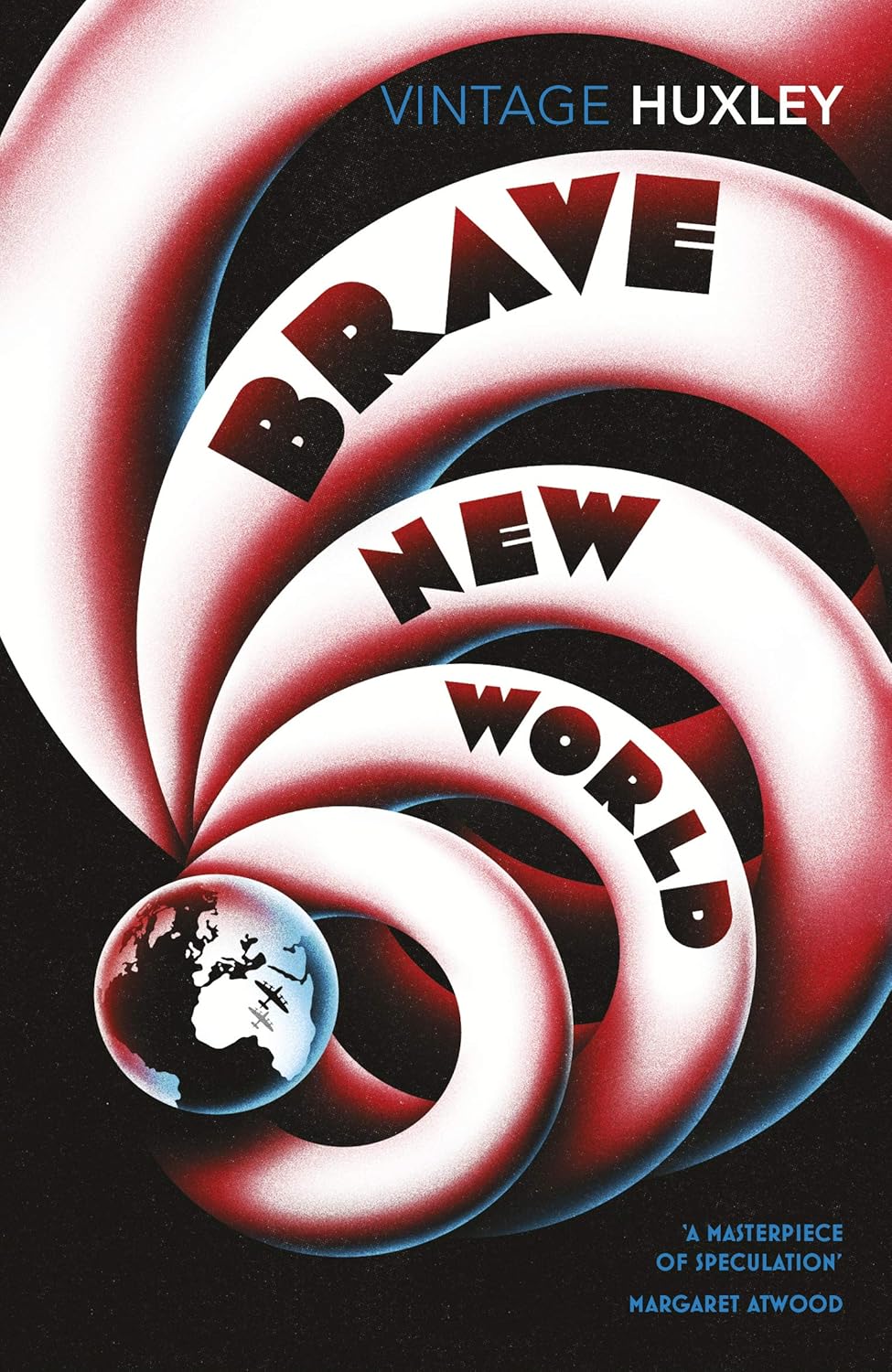
AUTHOR – ALDOUS HUXLEY
GENRE – Science Fiction
YEAR PUBLISHED – 2004 (Originally 1932)
PAGE COUNT – 288
READABILITY – Easy
MY RATING – 4.7/5
BRAVE NEW WORLD
What to expect?
- Just an unusual, first of its kind dystopian science fiction
Happiness as the Final Weapon
There is something uniquely sinister about a cage you cannot see. Aldous Huxley understood this when he wrote Brave New World in 1932 & he built his nightmare accordingly but from silk & sedatives. While Orwell would later give the world a boot stamping on a human face, Huxley offered something quieter & somehow worse: a human face, smiling, asking for more. This is not a novel about the end of the world. It is a novel about the end of the self, dressed up in the language of progress & gift-wrapped in manufactured joy. Nearly a century later, it has not aged. It has only grown more accurate.
A World Designed to Hollow You Out
The World State does not announce its cruelty. It never raises its voice. From the very first pages, Huxley pulls back the curtain on a civilization that has solved the problem of human unhappiness the way a surgeon solves the problem of a beating heart by removing it entirely (I know its dark). Children are not born here. They are decanted, engineered & psychologically gutted before consciousness has a chance to take root. The lower castes like Gammas, Deltas, Epsilons are chemically stunted in the bottle, their minds deliberately crippled so they lack the cognitive architecture to even formulate a grievance. They are not enslaved. They are designed for contentment, which is so much worse.
What the conditioning misses, soma finishes. This state issued narcotic does not merely dull pain as it erases the interior life entirely, smoothing over every tremor of existential unease before it can crystallize into something dangerous, like a question. Sex is compulsory in its casualness, intimacy systematically dismantled so that no two people ever love each other deeply enough to form an allegiance that might rival the state. Shakespeare is contraband. Solitude is pathologized. The family which is wounded, imperfect, irreplaceable has been abolished like a disease that has finally been cured. What remains is not civilization. It is a terrarium. Clean, climate controlled & utterly without wildness.
The People the World State Made & Unmade
John the Savage is where the novel truly bleeds. Raised outside the World State on a New Mexico Reservation, shaped by Shakespeare’s tragedies & the raw, unmedicated texture of genuine human suffering, he enters this gleaming civilization as a man carrying something the World State has no category for a soul. His collision with Mustapha Mond (the World Controller) is the dark philosophical heart of the book. Mond is not cruel. He is worse than cruel. He is reasonable, erudite & entirely at peace with having traded truth, beauty & God for a stable population of contented livestock. He made his choice with full understanding of what he was burying. He has no regrets. That tranquility is the most disturbing thing in the novel.
The Slow Erasure Dressed as Liberation
Huxley’s most suffocating argument is deceptively simple: the death of the human spirit does not require a tyrant. It only requires enough comfort. The World State does not break its citizens. It never needs to. It simply removes every condition under which depth, meaning or genuine selfhood might grow, grief, longing, sacred silence, the terrifying intimacy of real love & replaces them with sensation. What is left is not happiness. It is the absence of the capacity to know the difference. He was not imagining the future. He was watching the present & extrapolating with cold precision. Every algorithmic feed engineered for compulsion, every relationship flattened into transaction, every moment of silence crowded out by noise in the World State’s logic which is already operational. It just hasn’t finished yet.
Brave New World does not offer resolution. It does not extend a hand. It ends the way the most honest reckonings do in a silence that settles into the bones & stays there, long after the book is closed. Huxley stared into the specific abyss of modernity without blinking & what he saw, he rendered faithfully & without mercy.
Read it. Then sit quietly with what it leaves behind as it did for me. This is what the future holds for us!