PROPAGANDA
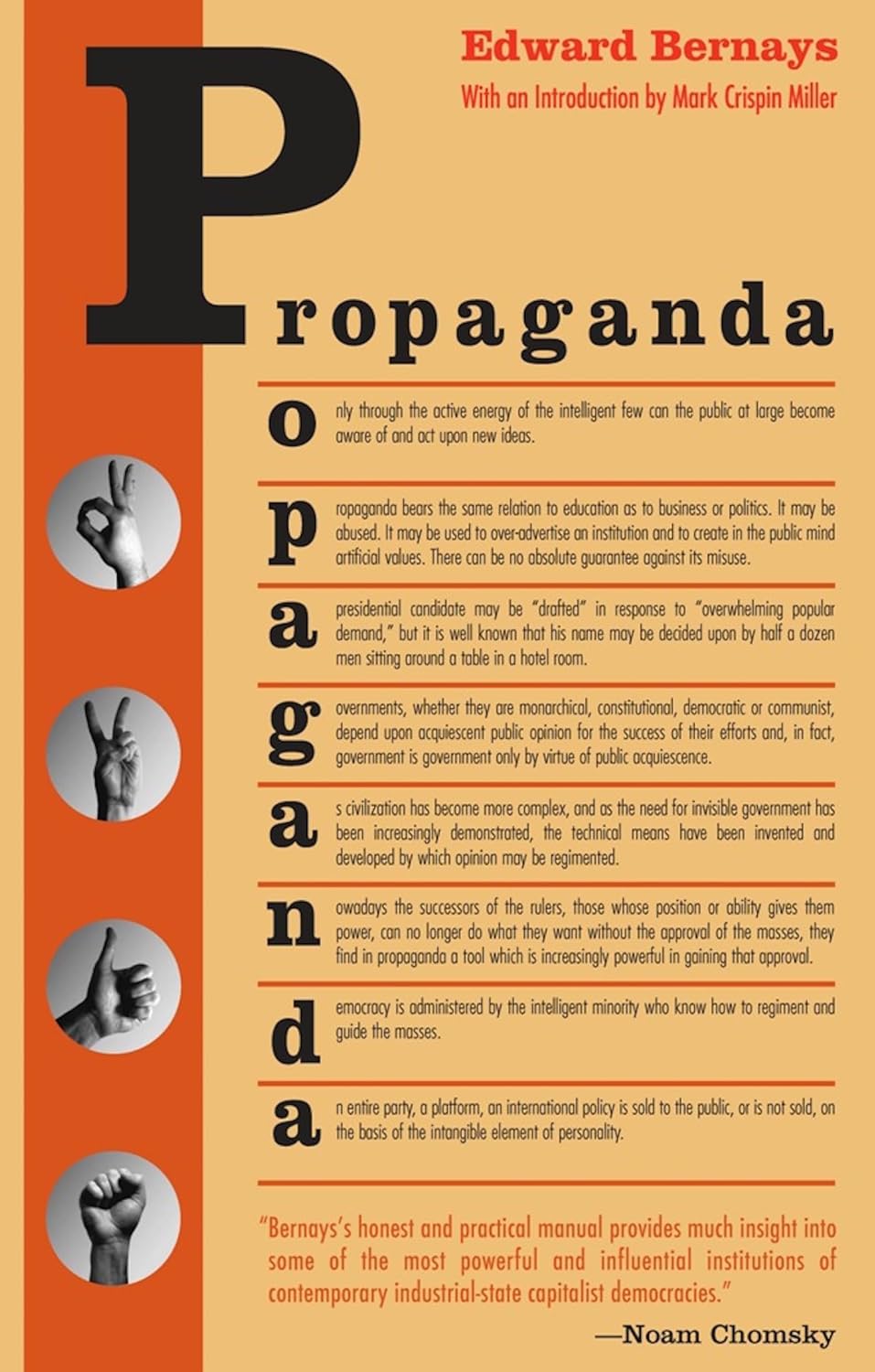
AUTHOR – EDWARD BERNAYS
GENRE – Politics
YEAR PUBLISHED – 2004 (Original 1928)
PAGE COUNT – 168
READABILITY – Easy
MY RATING – 4.4/5
What to expect?
- Why the term “Propaganda” has a negative connotation?
- How does Propaganda work? (With some use cases)
- What’s the shadow government? How they effectively use Propaganda?
- The cultural & individual impact of such manipulations
An Analysis of Propaganda
In Edward Bernays’ 1928 manual Propaganda, the author provides a remarkably candid & unapologetic exploration of how modern democratic societies are fundamentally managed by a hidden elite. While the text does not contain any references to a singular global “one world government” it serves as an exhaustive blueprint on the necessity & execution of a shadow invisible government, mass control, society engineering & culture control. Bernays, widely considered the father of public relations, strips away the idealistic illusions of democratic autonomy & reveals a world where the thoughts, tastes & political choices of the masses are continuously orchestrated by unseen experts working behind the scenes.
The Shadow “Invisible Government”
Rather than framing the “invisible government” as a sinister or illegal cabal, Bernays champions it as an absolute structural necessity for the survival of modern society. He asserts that because civilization has become so overwhelmingly complex, it is completely impossible for the average citizen to sift through the abstruse economic, political & ethical data required to make informed decisions. Therefore, society has voluntarily consented to let an invisible government “sift the data & high spot the outstanding issue” narrowing the field of choice to practical proportions.
This invisible government is composed of a relatively small number of persons a trifling fraction of the population who deeply understand the mental processes & social patterns of the masses. It is this elite managerial class that pulls the wires controlling the public mind, harnessing old social forces & contriving new ways to bind & guide the world. Bernays argues that whether we are buying a suit of clothes, voting for a presidential candidate or deciding what to eat for dinner, we are dominated by these invisible rulers. They govern us not through brute force but through their “qualities of natural leadership, their ability to supply needed ideas & by their key position in the social structure”.
Mass Control Through Mass Psychology
Bernays details how the modern propagandist achieves mass control by abandoning the outdated assumption that the human mind is a rational, individual machine. Drawing on the systematic study of mass psychology by thinkers like Trotter & Le Bon, Bernays notes that the group mind does not actually “think” in the strict sense of the word. Instead of rational thoughts, the mass mind is driven almost entirely by impulses, habits & emotions. Furthermore, because man is inherently gregarious, he feels himself to be a member of a herd even when he is alone in a room, meaning his mind permanently retains the patterns stamped onto it by group influences.
To control this mass, the propagandist relies on “clichés, pat words or images which stand for a whole group of ideas or experiences”. Bernays points out that simply tagging a concept with a loaded word can stampede millions of people into predictable emotional reactions. He gives the example of British evacuation hospitals during the war; when the public criticized them for insufficient care, the government simply changed the name to “evacuation posts” & the critical reaction immediately vanished because the new cliché removed the expectation of prolonged medical attention. By understanding these hidden, often suppressed desires & operating the correct psychological mechanisms, the invisible government can regiment the public mind exactly as an army regiments the bodies of its soldiers.
Society Engineering
A core component of Bernays’ methodology is society engineering is the practice of altering the underlying circumstances of society so that the public organically demands what the propagandist wants to sell. Bernays refers to this as the “newer salesmanship”. Instead of assaulting sales resistance with direct, aggressive advertising, the modern public relations counsel removes sales resistance by engineering a completely new social environment.
A famous example of this society engineering is a campaign to increase the sale of bacon. The propagandist did not launch advertisements claiming bacon was cheap or gave reserve energy. Instead, he engineered a medical consensus. Recognizing that the public heavily relies on the authority of physicians, he arranged for doctors to publicly state that a “hearty breakfast” is wholesome. Knowing with mathematical certainty that large numbers of people would follow their doctors’ advice, he successfully shifted the dietary habits of the nation. In another instance, to boost luggage sales, a propagandist might engineer a situation where railroads, steamship companies & foreign governments lower their baggage fees, thereby making travel easier & naturally driving up the demand for luggage without ever directly pitching the consumer.
Culture Control
Bernays also explains how the invisible government exercises culture control, actively shaping the aesthetic tastes, fashions & artistic standards of the masses. When mass production reaches a point where it can no longer compete on price alone, businesses must create a market based on aesthetic values. To do this, the propagandist creates a cultural trend.
When tasked with selling pianos, Bernays realized that people would not buy a piano just because it was advertised as high quality. Instead, he sought to control the culture by promoting the concept of the “music room” in the home. By organizing exhibitions of period music rooms, enlisting famous violinists, society leaders & influential architects to champion the idea, the music room became a cultural necessity. Consequently, the consumer bought a piano to fill their new music room, believing the purchase was entirely their own idea. Similarly, to revive the dying velvet industry, a propagandist was dispatched to Paris to secretly influence the couturiers (like Lanvin & Worth) to use velvet in their gowns. This engineered cultural shift in Paris immediately flooded the American market with a manufactured demand for velvet.
Additional Insight: The Manufacturing of “Events” & “News”
An incredibly important topic explored in the book is the deliberate manufacturing of “events” to create news. Bernays emphasizes that the modern propagandist does not just disseminate information; he is a creator of circumstances. Because newspapers prioritize “news value” above all else, the propagandist can guarantee media coverage by staging dramatic, undeniable events.
For example, when Thomas Masaryk was preparing to announce the independence of Czechoslovakia, he consulted with a propagandist who advised him to issue the declaration on a Monday morning rather than a Sunday. This was done because the press would have far more space to devote to the story on a Monday, ensuring maximum global impact. Another brilliant example is the Ivory Soap sculpture competition. By offering prizes for soap sculptures & enlisting schools & prestigious art galleries, the company created an ongoing, national “event” that generated massive, free news coverage & engaged children’s competitive & aesthetic motives. Through the creation of such high-profile events, the invisible government seamlessly weaves its propaganda directly into the daily news cycle, shaping reality right before the public’s eyes.