BETWEEN TWO AGES
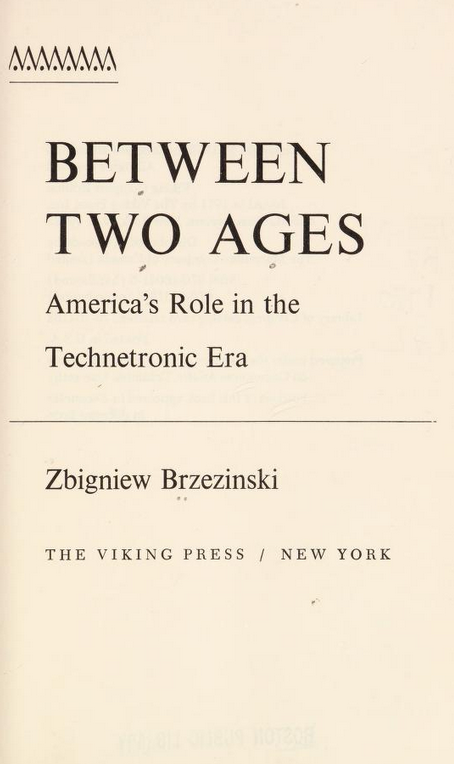
AUTHOR – ZBIGNIEW BRZEZEINSKI
GENRE – Geopolitics
YEAR PUBLISHED – 1982
PAGE COUNT – 334
READABILITY – Easy / Moderate
MY RATING – 4.5/5
What to expect?
- Can strict nationalism contribute in the progress of a nation?
- How leftist ideology will transform in the coming future
- What technology can be potentially be invented in the coming age?
- Why should U.S, Europe & Japan form an alliance? (The Pre Trilateral commission discussion)
- What went wrong in USSR & what can we learn from it?
Zbigniew Brzezinski’s Between Two Ages: America’s Role in the Technetronic Era provides a comprehensive socio political analysis of humanity’s transition from the industrial age into a post industrial, electronically driven reality. Brzezinski argues that the United States is the world’s principal disseminator of this “technetronic revolution” a transformation that radically alters social structures, global politics & the very essence of human identity. The text outlines the severe psychological & geopolitical turbulence generated as mankind moves into an intensely congested “global city,” warning that technology will outpace humanity’s intellectual & moral frameworks.
The Technetronic Arsenal: Global Grids & Future Weaponry
The core of Brzezinski’s analysis rests on the societal impact of computers, cybernetics & advanced telecommunications which he groups under the “technetronic” umbrella. He predicts the imminent arrival of an advanced network, noting that the United States is pioneering a “world wide information grid” expected to emerge around 1975, which will make the accumulated knowledge of mankind almost instantaneously available on a global scale. This electronic intermeshing is accompanied by the rise of future artificial intelligence & cybernetics, which will increasingly replace the human operation of machines & fundamentally alter the labor force.
However, the technetronic age also introduces horrifying new capacities for manipulation. Brzezinski warns of unprecedented biological & chemical tampering with the human being, noting that man is acquiring the capacity to manipulate the genetic structure, predetermine the sex of children & utilize biochemical means to control human behavior & intellectual functioning. Alongside this DNA tampering, advanced technology will birth terrifying new weaponry. He outlines a future defined by automated or manned space warships, deep sea installations, chemical + biological weapons & “death rays”. He even envisions weather tampering & warns of the technology to unleash accurately timed electronic strokes designed to seriously impair the brain performance of large populations over extended regions.
The Petrifaction of the USSR
Brzezinski delivers a harsh critique of the Soviet Union, illustrating how sticking strictly to orthodox communism has destroyed its capacity for modernization. While Stalinism successfully utilized brute force to push Russia into the industrial age, the bureaucratic rigidity of the Communist Party has now become the principal impediment to the country’s evolution. This “bureaucratization of boredom” has created a sterile environment where the Soviet communist party failed to produce a single creative Marxist thinker over a span of fifty years. Brzezinski asserts that “oligarchic petrifaction” & a paranoid insistence on dogmatic ideology stifle the free discussion necessary for scientific innovation. By maintaining a rigid, authoritarian political system & relying on a conservative, nationalist bureaucracy, the USSR fails to adapt to the technetronic age, hopelessly widening the technological gap between itself & the United States.
The Illusion of Leftist Ideology
The book views the militant “New Left” & contemporary student rebellions not as constructive political movements but as a reactionary “escape from reason”. Brzezinski equates these leftist rebels to the Luddites of the early industrial revolution, arguing that their romantic anarchism is an emotional, primitive reaction to the complexities of the computer age. Driven by “infantile ideology,” these groups elevate violence & action for action’s sake over rational, programmatic blueprints for the future. Their leftist ideology rejects the tedious necessity of mastering mathematics & systems control, relying instead on theatrical histrionics & outdated Marxist slogans that are entirely irrelevant to the problems of post industrial societies.
The Rise of China
In his assessment of the global balance, Brzezinski acknowledges the formidable rise of China, though he doubts its capacity to serve as a universal ideological model. China functions as a “self contained nation state” & its “Cultural Revolution” has deliberately separated it from the traditional communist mainstream. While its massive population magnifies its economic & social dilemmas, ensuring it will remain a relatively poor nation by the year 2000, its sheer material & military power will undoubtedly grow. Brzezinski warns that this growth will increase China’s capacity to threaten its neighbors & eventually, it will pose a direct threat to both the Soviet Union & the United States.
World Religious Ecumenism
The technetronic revolution also forces a profound crisis within institutionalized religions. Brzezinski observes that the historic fusion of beliefs with rigid institutions is crumbling, prompting movements like world religious ecumenism. Triggered by the reforms of Vatican II, this ecumenism seeks to heal doctrinal splits within Christianity & end bigotry toward non Christian religions, even initiating unprecedented dialogues between Catholic theologians & Marxist communists. However, this ecumenism creates severe institutional & doctrinal tension, as traditionalists fear the dilution of their faith. As the authority of the organized Church fades, Brzezinski predicts a “privatization of belief,” where individuals abandon rigid dogmas in favor of highly personal, unstructured & pluralistic spiritual relationships.
International Cooperation
Ultimately, Brzezinski posits that the survival of the congested “global city” depends on advanced transnational cooperation, specifically among the world’s highly developed nations. The book emphasizes the necessity of a community of developed nations, highlighting the structural focus on integrating Western Europe, Japan & the United States to manage global stability. Furthermore, Brzezinski references the vision of Soviet dissident physicist Andrei Sakharov, who advocated for a massive, cooperative Soviet American effort to tackle the crises of the Third World, promote disarmament & solve global ecological threats. This level of elite, functional cooperation across national borders is deemed essential to prevent mutual annihilation & manage the volatile fragmentation inherent in the technetronic era.
Conclusion
Ultimately, Between Two Ages portrays a world teetering on the precipice of a monumental & volatile historical transition. Brzezinski warns that as the technetronic revolution accelerates the sheer pace of scientific & electronic advancement threatens to overwhelm man’s psychological & institutional capacity to manage it. The United States, serving as the world’s social laboratory, stands at the epicenter of this chaotic transformation, projecting both its immense creative potential & its deepest social fractures onto the global stage. Without the establishment of a cooperative, transnational framework among developed nations, the congestion of the “global city” will inevitably breed violent fragmentation & catastrophic conflict. Humanity is thus left with a stark ultimatum: either master the terrifying new powers of technology for humane, universal ends, or succumb to an era of intellectual anarchy, profound alienation & absolute scientific despotism.