A HISTORY OF PHILOSOPHY: GREECE & ROME
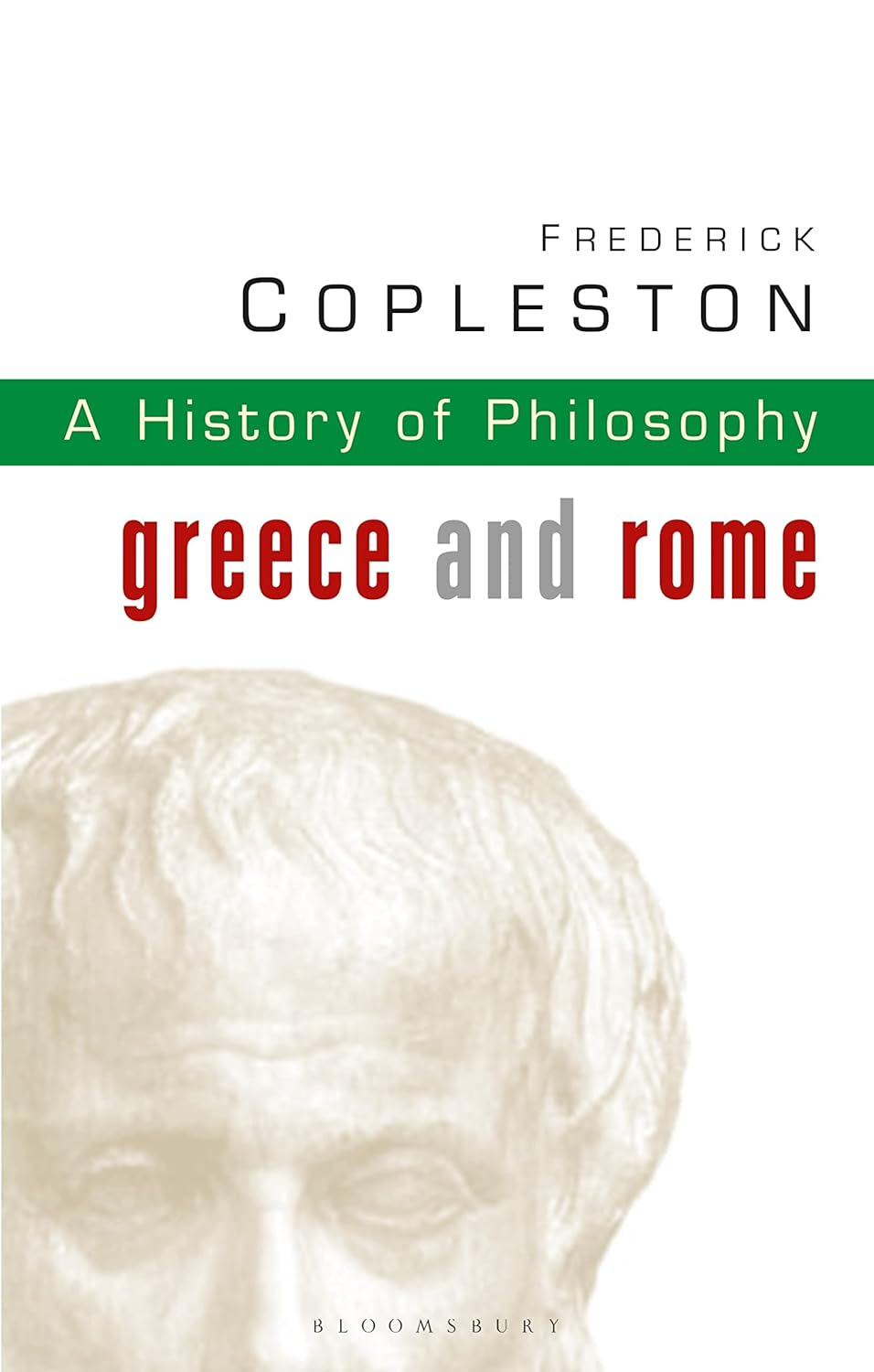
AUTHOR – FREDRICK COPLESTON
GENRE – History of Philosophy
YEAR PUBLISHED – 2003
PAGE COUNT – 544
READABILITY – Easy / Moderate
MY RATING – 4.1/5
What to expect?
- By far the best introductory book into History of Philosophy (personally)
- Goes very well in detail about Pre Socratics, Plato, Aristotle
- Written by a Jesuit Priest & some of his Catholic views can be visible in the writing
- Lots of Greek words in addition of the texts
Frederick Copleston, a Jesuit priest & professor at Heythrop College & the Pontifical Gregorian University in Rome, undertook exactly the task of compiling history of philosophy across nine volumes & the first, covering Greek & Roman philosophy from the pre Socratics through Plotinus & the Neoplatonists. It remains one of the finest single volume introductions to ancient philosophy available in any language.
The Pre Socratics: Philosophy Before Socrates
Copleston opens not with Socrates or Plato but the figures most people associate with Greek philosophy but with the earliest thinkers of the 6th century BC, the Milesians: Thales, Anaximander & Anaximenes. These men asked a question that seems simple but had never been asked in quite that way before: what is the fundamental stuff of which everything is made? Thales said water. Anaximenes said air. Anaximander proposed something more abstract i.e the apeiron, the indefinite or boundless. What matters is not the specific answers but the nature of the question itself. For the first time in recorded human thought, someone was attempting to explain the world through rational principles rather than mythological narrative. Philosophy had begun.
Copleston moves carefully through the major pre Socratic schools like Pythagoras & the mathematical mysticism of his followers, Heraclitus with his doctrine of universal flux & the hidden unity of opposites, Parmenides whose radical argument that change is an illusion & only Being truly exists & the pluralists like Empedocles, Anaxagoras & the atomists Leucippus & Democritus who attempted to reconcile the competing demands of permanence & change. Each thinker is presented in historical context, with Copleston carefully distinguishing what the ancient sources actually say from later interpretations & modern reconstructions.
Socrates, Plato & Aristotle
The book’s central sections covering Socrates, Plato & Aristotle are its strongest. Copleston’s treatment of Plato is particularly impressive for the way it moves through the dialogues chronologically, tracing the development of Plato’s thought from the early Socratic dialogues concerned with ethics & definition, through the middle period dialogues where the Theory of Forms reaches its fullest expression, to the late dialogues where Plato himself subjects his own theory to rigorous self-criticism.
The Theory of Forms is the doctrine that the physical world of particular things is a pale reflection of a higher realm of eternal, unchanging, perfect archetypes which receives clear & patient exposition. Copleston neither oversimplifies nor becomes lost in technical detail. He is equally attentive to the political philosophy of the Republic, the cosmology of the Timaeus & the late logical investigations of the Parmenides & Sophist, giving the reader a sense of Plato as a living thinker who developed & revised his ideas across a long career.
The treatment of Aristotle is equally thorough. Copleston covers the Categories & Logic, the Physics, the Metaphysics with its doctrine of substance, form & matter, potency & act, the four causes & the unmoved mover. The Nicomachean Ethics receives substantial attention & Aristotle’s account of happiness as eudaimonia, the doctrine of virtue as a mean between extremes, the role of friendship & the contemplative ideal of the philosophical life. The Politics & the theory of the state as natural to human beings rounds out this section. Throughout, Copleston draws clear lines of continuity & contrast between Plato & Aristotle, helping the us understand the relationship between the two most important thinkers in Western philosophy.
The Hellenistic & Roman Period
The final third of the volume covers the post Aristotelian schools like Epicureanism, Stoicism, Scepticism & Neo Pythagoreanism before closing with an extended treatment of Plotinus & Neoplatonism. This section is frequently underrepresented in introductory philosophy texts, which makes Copleston’s careful attention to it particularly valuable. The Stoic doctrines of the logos, of universal reason pervading all things, of living according to nature & of the distinction between what is in our power & what is not, receive clear & sympathetic treatment. The Epicurean account of pleasure & the good life is presented without caricature. The various schools of ancient Scepticism, Pyrrhonism & Academic Scepticism are distinguished with precision.
Plotinus, the 3rd century philosopher who systematized the Platonic tradition into what we now call Neoplatonism, receives the most extended treatment of any post Aristotelian thinker & rightly so. His doctrine of the three hypostases which is the One, Intellect & Soul plus his account of how all reality proceeds from & returns to the One, represents both the culmination of ancient Greek philosophy & a crucial bridge to early Christian theology. Copleston notes this bridge explicitly, pointing forward to Augustine, Pseudo Dionysius & the whole tradition of Christian Platonism that would dominate the medieval world.
Conclusion
What distinguishes Copleston throughout Volume 1 is his combination of historical precision & philosophical seriousness. He never condescends to his subject or his reader. He engages with the arguments on their merits, notes genuine difficulties & unresolved questions & resists the temptation to impose artificial tidiness on a tradition that was genuinely complex & contested. His own Thomistic philosophical commitments are present but never obtrusive as they inform his judgments without distorting his presentation. For anyone approaching ancient philosophy seriously for the first time, or returning to it after years away, A History of Philosophy Volume 1 remains the best single guide available. It has earned its place as a classic of philosophical scholarship not through novelty or provocation but through the quieter virtues of clarity, comprehensiveness & intellectual honesty.