THE MIND & THE BRAIN
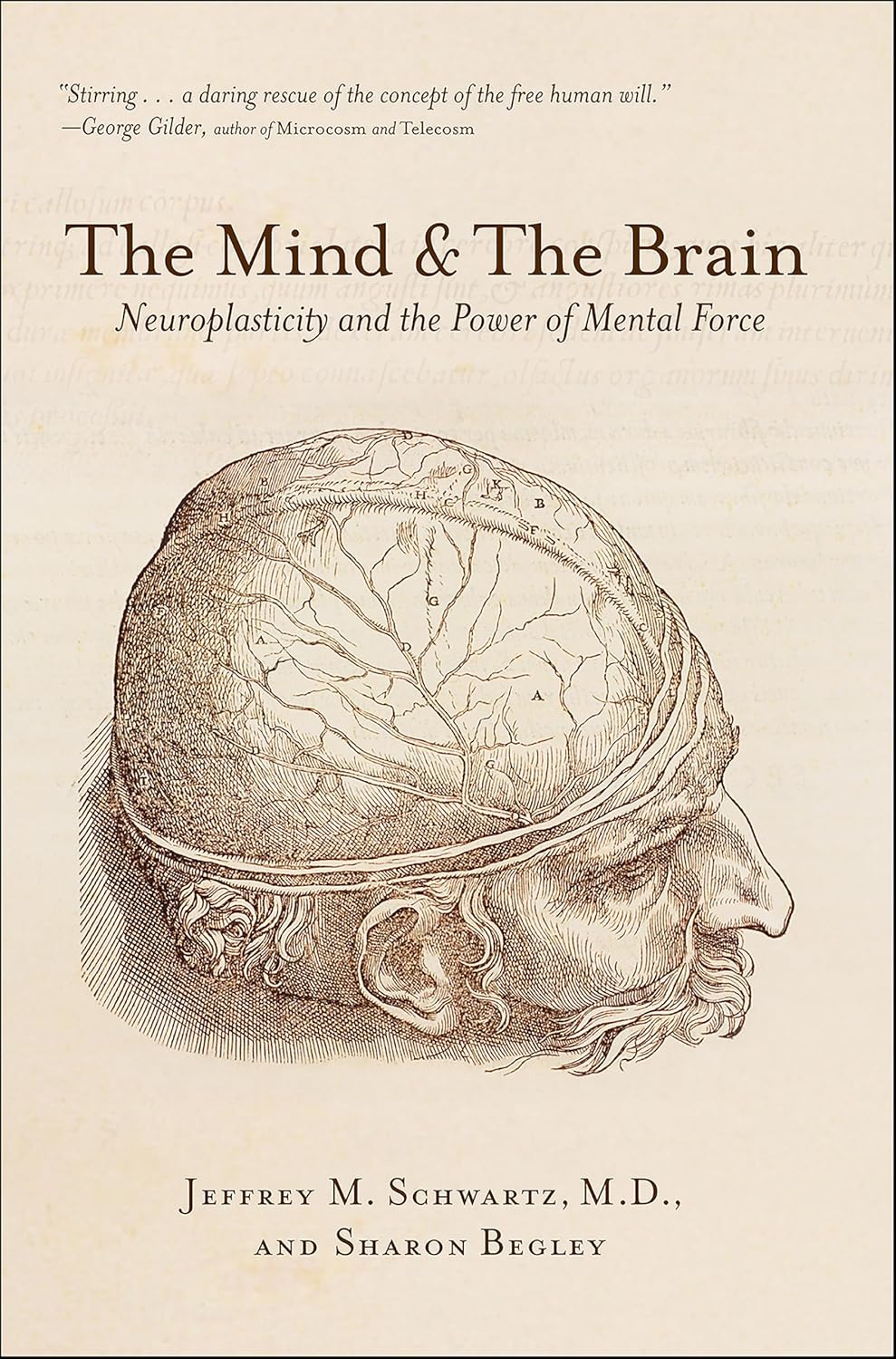
AUTHOR – JEFFREY M. SCHWARTZ, SHARON BEGLEY
GENRE – Science / Philosophy of Mind
YEAR PUBLISHED – 2009
PAGE COUNT – 432
READABILITY – Easy
MY RATING – 4.4/5
What to expect?
- Is Mind really emergent from Brain?
- What does Quantum theory say about Mind & Brain?
- What does Science say about Free Will?
- Is everything reducible to atoms? Is Materialism the only way forward?
Challenging the Materialist Hegemony
For centuries, the dominant paradigm in Western science has been materialist reductionism i.e “the philosophical conviction that all phenomena, including human consciousness, can be completely explained by the interaction, configuration & movement of material particles”. Under this framework, the human brain is viewed as a deterministic machine whose physical behavior is entirely predestined by the laws of classical physics, leaving no room for free will. In this modern scientific view, the mind does not exist independently of the brain, the subjective experience of “will” is dismissed as an illusory byproduct of neural firing.
The Mind and the Brain stands as a bold, scientifically rigorous challenge to this materialistic consensus. Combining groundbreaking clinical research in neuroplasticity with the foundational principles of quantum mechanics, the book provides a rational, coherent & intuitively satisfying framework demonstrating that the mind is not merely a passive prisoner of neural wiring but an active agent capable of reshaping the physical brain.
Neuroplasticity & the Discovery of Directed Mental Force
The first major pillar of the book focuses on neuroplasticity which is the revolutionary discovery that the adult human brain is not a hardwired, static organ but a dynamic system capable of forging new neural connections & blazing new paths through the cortex. Historically, science held that the adult brain’s architecture was fixed. However Jeffrey M. Schwartz leverage advanced neuroimaging technologies such as Magnetic Resonance Imaging (MRI) to observe the living, working human brain in real time. MRI scans demonstrate that even simple mental acts such as lifting a finger, reading silently, or imagining up a vivid mental image from childhood actively map & alter the corresponding regions of the brain.
To prove that the mind can consciously drive this physical alteration, the book presents a landmark clinical study involving patients suffering from Obsessive Compulsive Disorder (OCD). OCD is characterized by a constant, agonizing barrage of intrusive thoughts & powerful irresistible urges, most typically manifest as compulsions to wash or to check appliances & locks.
The patients were treated using a method known as Exposure & Response Prevention (ERP). During ERP therapy sessions, patients were deliberately presented with anxiety inducing triggers of varying intensity (such as a contaminated object) that sparked an intense urge to engage in a compulsive behavior. Instead of giving in, the therapist forced the patients to wait enduring the highly unpleasant, painful & intense anxiety without reacting.
The neuroimaging results of this therapy were profound. By deliberately shifting their attention away from the urge & refusing to engage in the compulsive behavior, patients successfully altered the metabolic activity of their caudate nucleus. This clinical breakthrough demonstrated the existence of Directed Mental Force i.e the intrinsic power of focused attention to physically reshape neural circuitry & alter cortical maps. It proved that the mind can systematically alter the physical embodiment of the brain.
The Foundations of Materialism: Newtonian Classical Physics
To understand why most of modern science rejects free will, the Jeffrey M. Schwartz trace the history of scientific thought back to the 17th century physics of Sir Isaac Newton. Classical Newtonian physics treats the universe as a clockwork machine governed by absolute, deterministic laws. In this “billiard ball” universe, if one knows the initial position & momentum of every particle, every future state can be mathematically predicted with absolute certainty.
When applied to biology, classical physics forces a reductionist view of humans. The brain is reduced to a complex arrangement of classical particles meaning every choice, thought & action is predetermined by the physical history of those particles. Under Newtonian laws, the mind is merely an “epiphenomenon” i.e a powerless shadow cast by the brain’s physical machine. Jeffrey M. Schwartz argue that this classical framework is fundamentally incomplete & deeply misleading when applied to human consciousness as it relies on an outdated physics that has been thoroughly superseded by modern science.
The Quantum Leap: The Double-Slit Experiment & the Observer Effect
Imagine you are listening to music from two speakers placed side by side. If both speakers play the same sound waves, the sound spreads through the room. In some places, the waves join together and become louder, while in other places they cancel each other and become quiet. This creates a strange pattern of loud and soft spots in the room. The Double Slit Experiment works in a similar way. Tiny particles like electrons act like sound waves when nobody is checking them, spreading out & passing through both slits at once creating a wave like pattern on the screen.
Now imagine you place a special detector near the speakers that tracks exactly which speaker the sound comes from. Suddenly instead of behaving like spreading waves mixing together, it is as if the sound behaves in a more direct & simple way. In the experiment, when scientists “watch” the electrons to see which slit they go through, the electrons stop acting like waves and behave like tiny solid particles again. The experiment teaches us that in the quantum world, particles can behave differently depending on whether they are being measured or not. This is called the “Observer Effect”
In the context of The Mind and the Brain, this quantum reality shatters the old materialistic view that your thoughts are powerless shadows cast by a predetermined, hardwired brain machine. Instead the book argues that because physical matter cannot even choose a definitive state of existence without an observer, your conscious mind holds genuine causal power. By deliberately choosing what you focus your attention on, your consciousness acts exactly like that quantum camera, stabilizing the hazy possibilities at the synaptic level and forcing your physical brain cells to lock into a newly structured, physically reshaped reality.
(I have simplified the Double slit experiment in here with much easier analogy)
The Quantum Resolution: Non-Locality and the Quantum Zeno Effect
Jeffrey Schwartz uses a simple quantum idea to explain how focused attention may influence the brain. Imagine your brain is like a busy road intersection where thousands of cars can choose different directions every second. Normally, traffic keeps changing constantly. But imagine a traffic police officer repeatedly signaling cars to go in one particular direction again & again. Over time, more & more traffic flows down that chosen road, and that path becomes stronger and more permanent.
Schwartz compares this to focused attention in the brain. Tiny brain particles & signals can potentially move in many possible ways, somewhat like “multiple possible traffic routes.” The Quantum Zeno Effect says that if a system is repeatedly “checked” or stabilized, it is less likely to change into something else. So, according to his theory, when you continuously focus your attention on a thought, behavior or goal, your mind repeatedly reinforces certain brain pathways instead of letting them drift randomly. Over time, those repeated mental choices can strengthen physical neural connections in the brain. In simple words: “what you repeatedly pay attention to becomes stronger in your brain.”
When applied to neurobiology, human volition acts through this exact mechanism. A person’s sustained focus of attention triggers the Quantum Zeno Effect at the synaptic level. By holding a chosen mental focus stable, the mind physically holds the corresponding neural circuitry in place, keeping it active & preventing it from losing focus or diffusing into background neural noise. This quantum framework entails that certain actions a person chooses to take are heavily influenced by a conscious stream of consciousness that is not strictly dictated or controlled by any known, deterministic law of nature.
Conclusion
Ultimately, The Mind and the Brain reframes the brain as the physical embodiment of the mind, the crucial organ through which the mind finds its expression & acts upon the world. By rescuing the human will from the scrapheap of materialist reductionism, the book achieves a profound philosophical victory. It successfully deploys the hard data of neuroscience and the mathematical realities of quantum theory to mend the historical breach between physical science and moral philosophy, restoring free will, personal responsibility, and purposeful human volition to their rightful place in human life.