THE LAST SUPERSTITION
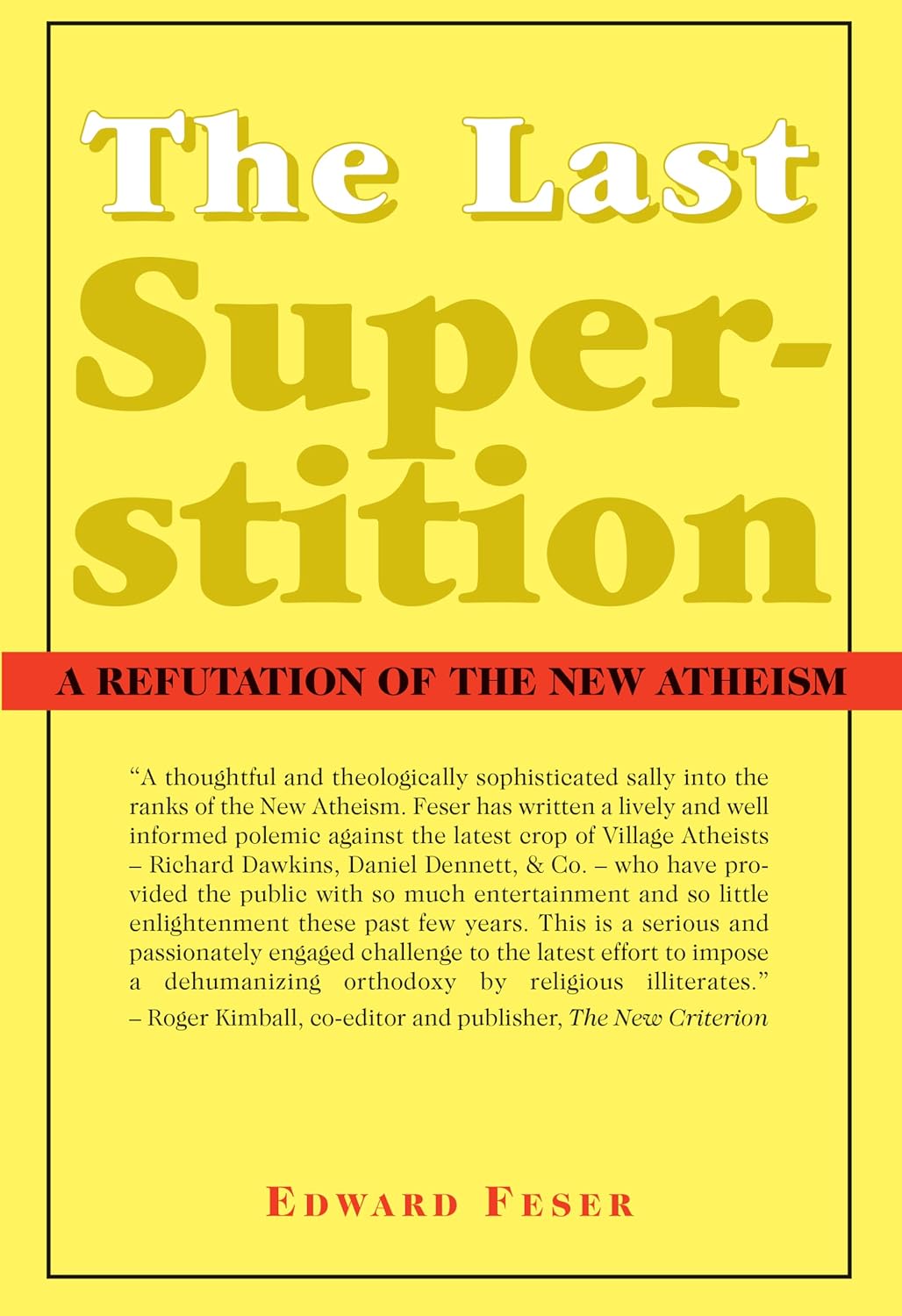
AUTHOR – EDWARD FESER
GENRE – Philosophy of Religion
YEAR PUBLISHED – 2010
PAGE COUNT – 312
READABILITY – Easy
MY RATING – 4.6/5
What to expect?
- Who are the New Atheists bunch?
- What philosophical argument does Aquinas put forward for the existence of God?
- Do these New Atheists really answer Scholastic philosophy?
- What does prominent thinkers say about religious belief?
- Can we live a dis teleological life with no purpose and no meaning?
The Modern Rejection of Teleology
In contemporary intellectual discourse, the rise of the “New Atheism” which is spearheaded by figures such as Richard Dawkins, Christopher Hitchens & Sam Harris has popularised the belief that scientific progress has rendered religious worldviews completely obsolete. Under this secular consensus, the universe is viewed as a cold, accidental machine composed entirely of material particles in motion, devoid of inherent purpose, meaning or design.
The Last Superstition by Ed Feser enters this debate not as a conventional defense of faith based on mystical experience but as a severe, highly aggressive philosophical counter offensive. The book argues that the true “superstition” of the modern age is not religion but secularism itself. By tracing the history of Western thought, the author asserts that the New Atheists do not actually refute traditional theology. Instead, they completely misunderstand the foundational Greek philosophy upon which classical monotheism rests.
The Conversion of Antony Flew & the Deficit of Secularism
The book opens by highlighting a massive historic shift in 20th century philosophy: The conversion of Antony Flew. Flew, who had been one of the world’s most prominent & dogmatic defenders of atheism for over fifty years, shocked the academic world at the age of 81 by changing his mind. His rationale was simple: “The Philosopher” referring historically to Aristotle had been right all along.
The volume leverages Flew’s conversion to demonstrate that a purely irreligious, materialistic worldview is ultimately irrational & structurally insane. To expose the psychological biases underlying modern skepticism, the book quotes prominent secular thinkers like Thomas Nagel who openly confessed, “I want atheism to be true… I hope there is no God! I don’t want the universe to be like that.” Ed Feser argues that this desperate desire to eliminate divine design has led to a ludicrous overuse of evolutionary biology to explain away everything from the complexities of the human mind to the origin of life itself. In reality, as physicist Paul Davies admits behind closed doors, the transition from inanimate matter to living, conscious organisms remains an absolute scientific mystery.
The Aristotelian Thomistic Framework: The Four Causes
The core philosophical project of The Last Superstition is the restoration of classical metaphysics, specifically the framework developed by Aristotle & later perfected by Thomas Aquinas. Central to this worldview is the doctrine of the Four Causes, which dictates that to truly understand any object or creature in reality, one must analyze it through four distinct lenses:
- Material Cause: The physical underlying matter out of which a thing is made.
- Efficient Cause: The external force or agent that brings the thing into existence.
- Formal Cause: The essential form, shape, essence or shared nature that makes a thing what it is.
- Final Cause: The intrinsic purpose, goal, end state or destination toward which a thing naturally points.
The author explains that the scientific revolution of the 17th century made a catastrophic error by deliberately abandoning formal & final causality. Thinkers like René Descartes & modern scientists like Richard Dawkins sought to reduce reality strictly to material & efficient causes, viewing the world as nothing more than isolated particles bumping into each other. Dawkins famously states that DNA is merely “software” & that our genes are “selfish” & “manipulative.” However, the author notes that genes are not conscious. Without an objective, intrinsic purpose or teleology driving them, the reductionist vocabulary of modern biology completely collapses into nonsense.
When formal & final causes are thrown away, cause & effect become completely “loose & separate.” If things have no shared forms or essences & nothing intrinsically points beyond itself toward an end goal, there remains no objective reason why any specific cause should produce any specific effect. Color, odor & taste are stripped of objective reality & dismissed as mere illusions of the human mind.
The Immaterial Soul & the Limits of Materialism
The book applies this metaphysical critique directly to human nature, refuting the claim that the mind is merely the physical brain. Humans are an inseparable composite of form (the rational soul) & matter (the physical body). To prove that the intellect cannot be reduced to material particles or neurological firings, the author highlights the critical distinction between mental images & concepts.
A computer or a brain can store images, sounds & physical patterns but human beings can grasp universal truths that are not tied to any particular image or material object. For e.g, you understand the concept of a perfect triangle even though no perfect triangle has ever existed in nature. Every triangle you have ever seen is imperfect yet your mind understands an exact, universal idea of “triangularity” itself. The same is true for infinity, justice, logic, numbers or a chiliagon. You can know precisely what a 1000 sided polygon is even though you cannot form a clear mental picture of it. Your imagination fails but your intellect still succeeds.
This creates a philosophical problem for strict materialism. Physical brain states are always particular, limited & concrete. They are specific electrical & chemical events happening at one place & time but abstract concepts are universal & immaterial. The number “2” is not made of atoms, located in space or shaped like anything physical yet the human mind can directly understand it. If thoughts were nothing more than material brain activity, then all thinking should be reducible to images, chemistry or physical patterns. Abstract reasoning goes beyond imagery & sensory experience entirely.
Ed Feser then concludes: since humans possess an intellect capable of grasping universal, immaterial truths, the intellect itself cannot be wholly material. Matter can represent individual things but universal concepts transcend matter. Therefore there must be an immaterial aspect of the human person which is traditionally called the rational soul, that is capable of abstract thought. Immaterial things are not composed of physical parts that decay, this suggests the possibility that the rational soul is not destroyed in the same way the body is, pointing toward immortality.
Conclusion
Ultimately, The Last Superstition presents a diagnostic verdict on modern secular culture: it suffers from a profound, systematic blindness. The secularist has committed to an artificial, reduced view of physics, they are blind to the higher dimensions of reality. Ed Feser concludes with a symmetry of warnings: where the material world points beyond itself to an Ultimate First Cause (God), the secularist sees only raw matter; where human nature points to an immortal soul, the secularist sees only the physical brain & where the sexual act naturally points beyond itself to the creation of marriage & family life, the secularist sees nothing more than a mechanical, transient physical act. By exposing these foundational errors, the book offers a powerful defense of classical reason against modern materialistic dogmatism.