EPISTEMOLOGY: CLASSIC PROBLEMS & CONTEMPORARY SOLUTIONS
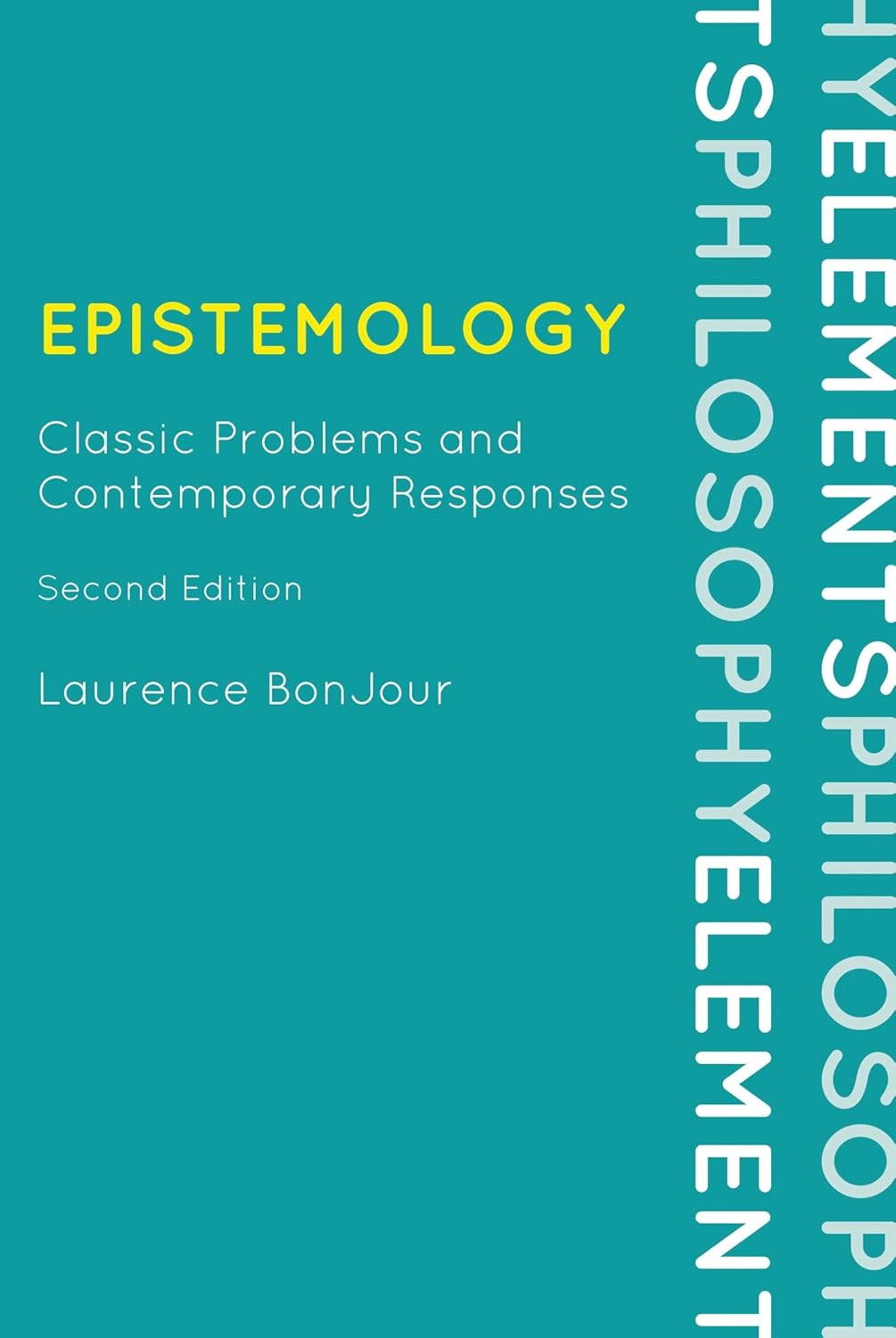
AUTHOR – LAURENCE BONJOUR
GENRE – Philosophy
YEAR PUBLISHED – 2009
PAGE COUNT – 329
READABILITY – Intermediate / Hard
MY RATING – 4.8/5
What to expect?
- This book is not for beginners
- Discusses about “what is Justified True Belief”? Why should our belief be true and justified?
- Bonjour explains about all the contemporary epistemical problems that has been in the History of Philosophy
- Bonjour also provides possible solutions for them
- Covers topics like skepticism of Hume, Cartesian Foundation, Analytic/Synthetic distinction.
I. The Cartesian Foundation, Radical Doubt & the Metaphysical Divide
Epistemic Goal & Metaphysical Context
Laurence BonJour frames the central task of epistemology as establishing a rational bridge from internal, subjective mental states to a verifiable, independent external reality. This inquiry operates against a foundational metaphysical divide: Theistic worldviews, which posit that essence precedes human existence & materialist or existentialist frameworks, which assert that existence precedes essence.
Descartes’ Methodological Skepticism
To isolate an unshakable foundation for knowledge, René Descartes implemented an uncompromising heuristic: Tentatively rejecting any belief, opinion or principle that is not completely certain & indubitable. If a singular, conceivable reason for doubt exists, the claim is discarded to eliminate cognitive error. To test the resilience of human belief, Descartes formulated systemic thought experiments questioning sense data & mathematical certainties, culminating in the hypothesis of an omnipotent, malicious “evil genius” dedicated entirely to manipulating his consciousness.
The Isolation of the Bedrock
By stripping away all vulnerable assumptions, Descartes isolated his ultimate, indubitable starting point: Cogito, ergo sum (“I think, therefore I am”). This foundational truth establishes that even under total deception, one must necessarily exist as a thinking entity to experience that deception. The Cogito strictly guarantees existence as a “thinking thing” like a mind, intellect or understanding that doubts, affirms, wills, imagines & senses rather than a physical, historical person.
Core Historical Counter Arguments
- The Internal Deception Critique: This challenge questions whether an omnipotent deceiver could manipulate a person’s awareness of their own immediate mental states (e.g. falsely causing an individual to believe they are experiencing a specific visual data like a green square). While it is deeply difficult to determine if one can believe they are having an immediate experience without actually having it, Descartes concluded that two certainties survive skepticism: The fact of one’s existence as a thinking thing & beliefs regarding the immediate contents of one’s mind.
- The Problem of Inference: Moving beyond solipsism requires a background premise that external objects explain internal ideas. Descartes acknowledged that prior to his methodological doubt, his reliance on this causal link was merely a “blind,” spontaneous impulse of nature rather than a rationally justified principle. His later attempt to bridge this gap by arguing that the internal idea of an infinite, perfect God requires God as its actual external cause similarly relies on an unverified causal background principle.
- The Question Begging “I”: Critics like Bertrand Russell, echoing Georg Lichtenberg argued that Descartes use of the pronoun “I” is grammatically convenient but philosophically illegitimate. Russell asserted that Descartes begged the question by presupposing a substantial, unified self in the premise “I think” to establish “I exist.” From a strict epistemic standpoint, Descartes was only entitled to state “there are thoughts” or “there is pain.” (This is one the presupposition that Descartes was assuming)
II. The Traditional Concept of Knowledge & the Gettier Modality
Justified True Belief (JTB) formulation
The Cartesian account aligns with the traditional conception of knowledge originally formulated by Plato, which dictates that a subject knows a given proposition (‘X’) if & only if three essential, individually necessary & jointly sufficient conditions are met:
- The Belief Condition: The subject must actively believe or accept ‘X’ to be true, as knowledge cannot coexist with serious doubt or total unfamiliarity.
- The Truth Condition: ‘X’ must be objectively true, independent of what the subject thinks, since the cognitive enterprise aims to accurately describe reality.
- The Justification Condition: The subject must possess strong epistemic reasons or evidence that significantly enhance the likelihood that the belief is true, distinguishing genuine knowledge from a lucky guess.
Competing Theories of Truth
- Correspondence Theory: A proposition is true if it directly corresponds to or agrees with an objective, independent aspect of reality.
- Coherence Theory: The truth of a proposition consists purely in its logical consistency & mutual explanatory support within a wider web of already accepted beliefs.
- Pragmatic Theory: A belief is true if holding it leads to practical success & functional utility. BonJour highlights a fatal flaw here, arguing that pragmatism reverses the order of causation: A belief does not become true because it produces success but rather it produces success precisely because it is already true in the correspondence sense.
Epistemic Thresholds & the Gettier Problem
Regarding justification, modern epistemologists split between a strong conception (requiring absolute, infallible reasons that guarantee truth) & a weak conception (requiring reasons that make a proposition highly likely to be true without demanding an absolute guarantee). The weak justification model is vulnerable to the Gettier Problem.
Using an archery analogy, BonJour explains that if a person shoots an arrow at a target & a random gust of wind alters its path at the last instant to hit the bullseye, the success is accidental. In a Gettier case, a subject achieves a justified true belief but the alignment between justification & truth is purely coincidental. To resolve this flaw, a fourth condition must be added to the traditional definition: the subject’s justification for the belief must not be an accident.
III. David Hume & the Inductive Imperative
The Core Skeptical Dilemma
Inductive reasoning operates by observing particular, past instances to arrive at a general conclusion or by assuming that unobserved instances will mirror observed ones with high probability. David Hume argued that this inferential transition from evidence to conclusion is completely unjustified by rational standards, functioning instead as a product of conditioned habit formation. Hume demonstrated that induction cannot be vindicated by either available mode of reasoning:
- A Priori Reasoning: Inductive inferences cannot be justified a priori (independent of experience) because it is always logically possible to conceive of the course of nature changing without contradiction (e.g an ice cube failing to dissolve in water).
- A Posteriori Reasoning: Appealing to past empirical success to prove induction creates a fatal circular argument. One cannot use past observed successes of induction to justify future unobserved instances without implicitly relying on the very inductive principle being questioned.
Three Fold Scope of Inductive Skepticism
- Common Sense Expectations: It strips away our rational justification for basic daily assumptions (e.g whether a wooden floor will support our weight). It eliminates any logical reason to assume that macroscopic objects continue to exist when unobserved.
- Scientific Belief: Theoretical science relies on unobservable entities (such as electrons). While scientists argue these processes offer the best explanation for observable experimental patterns, those underlying patterns are themselves established via induction. If induction is unjustified, advanced scientific beliefs collapse into irrationality.
- Historical Knowledge: Justification for past historical events relies on artifacts, documents & reported memories. To trust these items as reliable traces of past events requires inductively established generalizations regarding how evidence is produced.
Historical Responses & Their Failures
- The Pragmatic Vindication: Hans Reichenbach & others argued that induction is guaranteed to find the truth in the “long run” if any discoverable truth exists. The flaw is that no finite length of time can guarantee or even make it likely that a sample size is long enough to reflect the ultimate state of nature.
- Ordinary Language Justification: This view posits that deduction & induction are autonomous modes of reasoning with separate, independent standards of correctness. The flaw is that this approach fails to address the deeper epistemic question of whether the autonomous standards of induction are actually reasonable or likely to yield true conclusions.
- The Convergence Response: This model suggests that if an objective regularity exists, a sustained series of observations will naturally tend to reflect it once chance variations cancel out. Yet this remains vulnerable to Hume’s warning that the underlying course of nature can still shift.
IV. A Priori Justification & the Rationalist Empiricist Divide
Defining the A Priori
A priori justification provides knowledge that is independent of sensory & introspective experience. BonJour clarifies a key distinction: a priori justification can utilize past sensory experience as an essential precondition for understanding the concepts within a proposition, provided that experience does not serve as the formal reason for believing the proposition is true (e.g using physical blocks to learn the concepts of “two” & “three” but relying on pure rational reflection to realize that 2 + 3 = 5).
The Logical Necessity Argument
BonJour presents a powerful defense of the a priori based on the nature of reasoning itself. To reason is to make a mental transition from one proposition to another in a way that provides conditional justification. This conditional link must be a priori in character. If all justification required empirical, sensory tracking, the fluid transition of logical thought would be impossible.
The Analytic Synthetic Divide
The divide regarding how this rational insight functions is mapped across two camps:
- Moderate Empiricism & Analytic Claims: Moderate empiricists argue that a priori justification is real but trivial, deriving entirely from the definitions of words. Immanuel Kant termed these Analytic propositions where the predicate concept is explicitly contained within the subject concept (e.g “All bachelors are unmarried”). These are viewed as simple tautologies carrying no expansive information about the actual universe.
- Rationalism & Synthetic Claims: Rationalists argue that a priori insight extends to Synthetic statements i.e propositions where the predicate is not linguistically contained within the subject yet can be seen as necessarily true by the light of reason (e.g “Nothing can be red & green all over at the same time” or “No object can be spherical & cubical at the same time”).
The Infallibility Problem & Universals
Historically rationalists claimed that a priori insights were infallible. BonJour rejects this, noting that human cognitive processes are always subject to errors stemming from distraction, confusion & a lack of full attention.
To explain how the mind accesses these abstract truths, the book references Bertrand Russell’s theory of Universals. Universals (such as numbers or the property of redness) are non physical, non mental abstract entities existing outside of space & time. According to Russell, human minds become acquainted with these universals by abstracting them from particular instances, allowing us to directly apprehend the necessary relations between them to form a priori knowledge.
V. Immediate Experience, Illusion & the Perceptual Interface
The Complex Causal Pipeline
BonJour examines the mechanics of perception, analyzing why many philosophers conclude that humans never directly encounter physical objects. He uses the example of seeing a light yellow sphere in a yard to demonstrate that our immediate experience is merely a localized, colored region within our visual field.
The immediate mental experience is the end product of a highly complex causal chain involving ambient light, atmospheric clarity, the biological health of the eye & optic nerve & neurological processing within the brain. Because any alteration along this biological pipeline changes the immediate internal experience even if the external object remains completely unchanged, the direct object of our awareness must be an internal mental state rather than the external physical entity.
Competing Theories of Immediate Experience
- The Sense Datum Theory: This model posits that the entities directly given in sensory experience are distinct objects called sense data, which possess the exact qualities we immediately perceive. Proponents use the Argument from Illusion to validate this view. If a straight stick is partially immersed in water, the immediate object within the observer’s visual field is undeniably bent. Since the physical stick is not bent, the immediate object of experience cannot be identical to the physical stick, it must be a non material sense datum.
Historically, George Berkeley argued that these sense data are strictly two dimensional, claiming that the third dimension of distance is fundamentally invisible to the eye. However, the sense datum theory faces severe internal difficulties regarding whether these data can exist when unobserved & whether the same sense datum can be experienced by multiple people.
- The Adverbial Theory: Formulated as an alternative to avoid creating an intermediate layer of non material objects, the adverbial theory reinterprets perception not as the inspection of a mental thing but as a modification of the mind’s activity. Instead of saying “I perceive a blue sense datum”, the adverbialist says “I am sensing bluely”. BonJour notes a major flaw in this theory: It provides no clear understanding of the actual nature of these mental states, failing to explain how they account for the rich, structured character of immediate experience.
VI. Epistemological Models of the External World
1. John Locke & Representative Realism
John Locke used the term Idea to refer to any conscious content, categorizing the distinct contents of sensory experience as Ideas of Sense. Locke argued that our beliefs about external material objects are justified because these ideas of sense are systematically produced by exterior physical causes. He offered two primary defenses for this claim, both of which face significant flaws:
- The Physical Verification Argument: Locke pointed to the physical operations of other people’s sense organs to verify the external causal network. The Flaw: This argument is circular. Sense organs are themselves physical structures. Beliefs about another person’s eyes or ears require the very same empirical justification that is currently being questioned.
- The Involuntary Argument: Locke noted that ideas of sense are involuntary & independent of our will, forcing themselves upon our consciousness in a way that voluntary imagination does not. The Flaw: An involuntary experience does not logically guarantee an external material cause. The orderly, involuntary sequence could be produced by a subconscious or unconscious faculty within the subject’s own mind. Furthermore, involuntariness does not prove that an external cause matches the specific properties portrayed by the internal experience.
While Locke emphasized that our sensory ideas fit together into a highly complicated, coherent & law governed whole, BonJour points out that a creative artist or novelist can deliberately construct a similarly complex, orderly world within imagination, meaning coherence alone does not provide a definitive link to a material universe.
2. George Berkeley & Idealism
George Berkeley accepted the premise that the mind only encounters internal ideas but rejected Locke’s belief in an unobservable material realm as an unnecessary & unjustified assumption. Berkeley argued that the orderly, coherent & involuntary nature of our sensory ideas is determined & sustained directly by the mind of God. In this idealist framework, material substances do not exist. Reality consists entirely of conscious minds & the ideas projected into them by the Divine Creator.
3. David Hume & Radical Skepticism
David Hume rigorously pursued the logical consequences of Locke’s & Berkeley’s premises leading to what BonJour describes as an epistemological dead end. Hume denied that any attempt to explain our internal experiences by appealing to an independent world of external causes could ever be rationally justified. He established that causal relations can only be known by experiencing a regular sequence of cause & effect. Because humans only have access to internal perceptions & can never step outside of them to observe the external object causing them, it is impossible to verify a causal link between the unobserved world & our immediate experience.
Hume explained that our common sense belief in the continuous, independent existence of objects (such as assuming a bed remains the same when we leave the room) is a psychological illusion constructed by the mind through imagination & memory. Our raw sensory input consists of discrete, isolated impressions. When the mind encounters chains of resembling impressions, it uses imagination to smooth over the gaps, inventing the concept of a persistent, continuous physical object. This view parallels Buddhist theories of momentariness, which assert that nothing exists for more than a single moment. Ultimately, Hume concluded that the true causes of our impressions are completely unknown & unknowable, leaving us trapped in a deep, skeptical isolation.
4. Direct Realism as the Contemporary Alternative
Once Phenomenalism i.e the view popularized by John Stuart Mill that material objects are nothing but “permanent possibilities of sensation” is rejected as an untenable dead end, contemporary philosophers are left with a definitive choice. If representative realism cannot fully overcome Hume’s causal critique, many thinkers turn to Direct Realism.
The direct realist asserts from an intuitive, pre theoretical standpoint that when an individual stands in a yard watching dogs near a bush, the actual physical, material objects themselves are immediately present to the conscious mind. While acknowledging that the internal experience involves complicated patterns of shape & color, the direct realist maintains that any framework denying the immediate presence of the physical world is simply mistaken about the facts of human perception.
Conclusion
Laurence BonJour’s Epistemology leaves the reader with a clear choice regarding our knowledge of the external universe. The rejection of phenomenalism narrows the field down to an unavoidable dilemma: Philosophers must either yield to total skepticism by admitting that the human mind is permanently confined within its own subjective theater, entirely unable to verify the existence of an independent world or they must find a way to rationally validate representative realism to successfully bridge the gap between subjective thought and objective physical reality.