METAPHYSICS
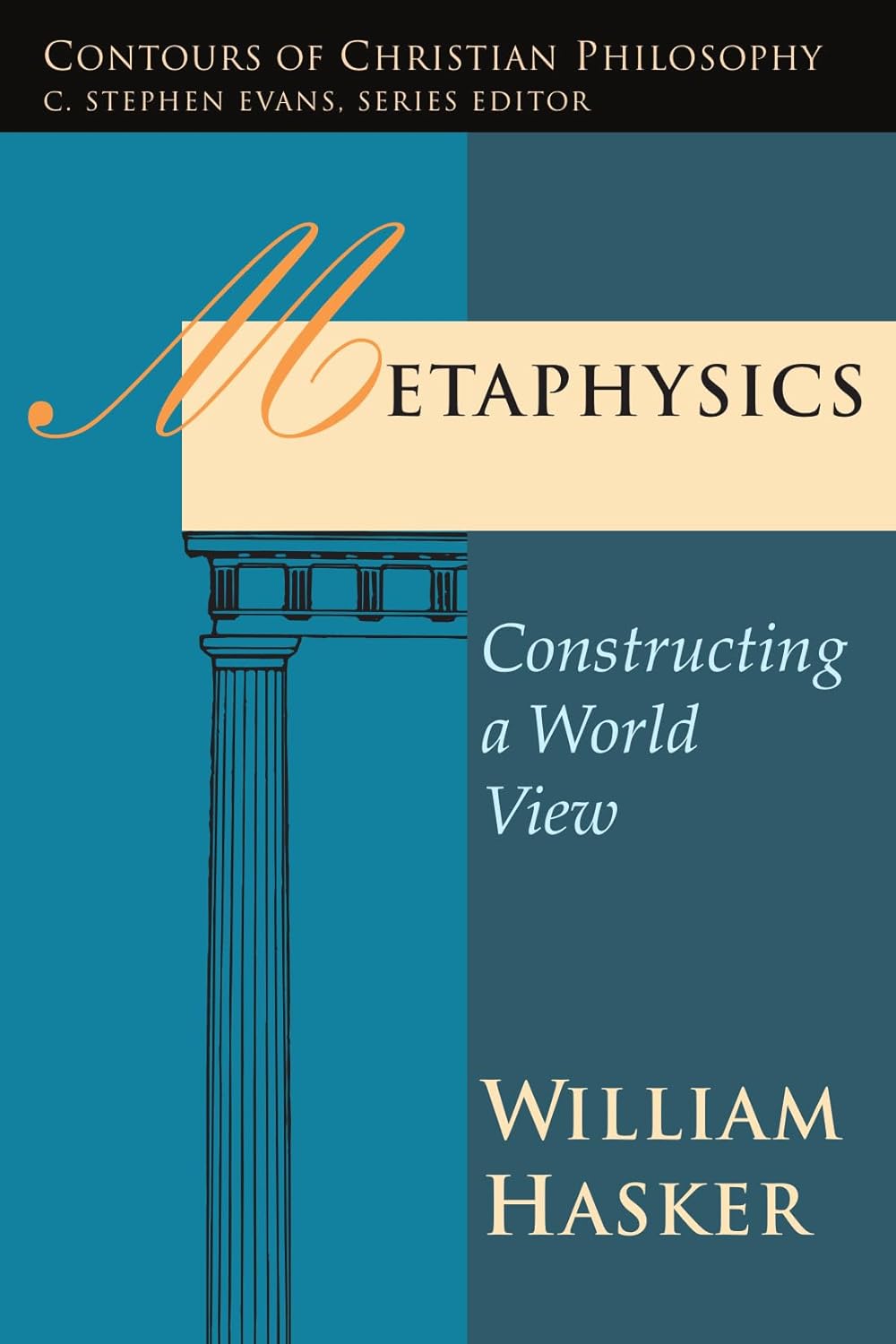
AUTHOR – WILLIAM HASKER
GENRE – Philosophy
YEAR PUBLISHED – 1983
PAGE COUNT – 132
READABILITY – Easy
MY RATING – 4.3/5
What to expect?
- Introduction to Metaphysics
- Hasker discusses about Free will & alternatives, God’s foreknowledge,
- This book is written in a Christian perspective
The Nature of Metaphysical Frameworks
Metaphysics is the foundational branch of philosophy concerned with establishing a coherent & comprehensive view of reality. In Metaphysics: Constructing a World View, philosopher William Hasker guides us through the core structural puzzles that define our understanding of existence, time & agency. A central insight of Hasker’s text is that metaphysics must operate using foundational assumptions that cannot be easily proven by absolute deductive logic or direct sensory experience. Principles such as “nothing we do now can change the past” & “nothing begins to exist without a cause” are fundamentally difficult to establish as flawless premises yet they remain indispensable rules that humans must rely upon to construct a workable world view . Hasker’s volume functions as a highly accessible blueprint for beginners, systematically mapping how these abstract principles govern the real world tensions between causal determinism, human freedom & theological necessity.
The Mechanics of Determinism
Before evaluating human freedom, Hasker establishes a clear, rigorous definition of determinism plus the thesis that every event, including human choices & actions, is the inevitable & necessary result of preceding causes combined with the absolute laws of nature. To make this beginner friendly, the text isolates the structural core of the deterministic argument:
- The Inevitability Premise: Given the exact state of the universe at any past moment & given the constant laws of nature, only one unique future is physically possible.
- The Problem of Origin: If determinism is true, any choice you make today is merely the final link in a causal chain that extends backward in time to long before you were born. Because you have no control over the events of the remote past or the laws of nature, you cannot logically be the ultimate source or author of your own actions.
The primary objection to this view is that it runs completely counter to our immediate, pre theoretical psychological experience. When making a decision, we feel internally certain that multiple alternative paths are genuinely open to us. Determinism exposes this subjective experience of choice as a persistent psychological illusion.
The Free Will Trilemma: Competing Philosophical Models
Hasker maps out the problem of free will by classifying the major philosophical responses into clear, competing paradigms. This framework divides cleanly along the lines of incompatibilism & compatibilism.
1. Incompatibilism
Incompatibilist theories assert that free will & determinism are logically contradictory & cannot both be true at the same time. If the universe is deterministic, freedom is an illusion; if freedom is real, determinism must be false. Within this camp, Hasker analyzes two radical paths:
- Hard Determinism: This view accepts the reality of causal determinism & logically concludes that human free will does not exist. Hard determinists argue that our traditional concepts of moral responsibility, praise & blame are fundamentally irrational as no criminal or hero could ever have acted differently than they did.
- Libertarianism: This view rejects determinism to rescue human freedom. Libertarians maintain that while the physical world follows strict causal laws, human agents possess a unique capacity to act as independent causal starting points. For a libertarian, an action is only genuinely free if the agent possessed the power to choose an alternative course of action under the exact same circumstances.
2. Compatibilism (Soft Determinism)
To bridge the gap between science & human experience, compatibilists argue that free will & determinism are entirely compatible & can coexist without logical contradiction. Compatibilists redefine “freedom” not as the absence of prior causes but as the absence of external coercion or physical restraint. Under this view, your choices are free as long as they flow naturally from your own internal desires, motives & character traits even if those internal desires were ultimately caused by prior genetic, psychological & environmental factors. If you sit down to read because you want to read, your action is free in the compatibilist sense, even though your desire was causally determined.
The Scientific Disruption: Quantum Physics and Randomness
A critical chapter in Hasker’s text examines how modern changes in the physical sciences have shifted the free will debate. For centuries, classical Newtonian mechanics provided the ultimate scientific defense for hard determinism, portraying the cosmos as a clockwork machine where knowing the precise position & momentum of every particle would allow a perfect intellect to calculate the entire future with absolute certainty.
Hasker demonstrates that the rise of contemporary physics specifically quantum mechanics, fundamentally shattered this classical predictability. At the subatomic level, quantum mechanics reveals that physical events do not follow strict, deterministic trajectories. Instead particles behave according to inherent probabilities & indeterminacy. However Hasker warns beginners against assuming that quantum physics automatically rescues human free will. If subatomic movements are purely random, uncaused or probabilistic events, they do not equate to deliberate human choice. Randomness is just as hostile to moral responsibility and intentional agency as absolute causal determinism. A person whose actions are caused by random subatomic fluctuations is a victim of chance, not an autonomous agent in control of their destiny.
The Theological Matrix: Foreknowledge and Fixed Futures
The final, most profound movement of Hasker’s analysis investigates the metaphysical crises that occur when human freedom is evaluated within a theological framework. Specifically, the text explores the intense logical friction between human free will & divine foreknowledge. Hasker systematically tackles a traditional solution often proposed by theologians: the argument that God does not actively determine or cause the future but merely foreknows what an individual will freely choose. While this distinction is designed to safeguard human moral responsibility by decoupling divine knowledge from physical coercion, Hasker reveals that it fails to solve the underlying logical problem.
The issue is not about coercion but about necessity. If an omniscient deity knows with absolute, infallible certainty from the beginning of time exactly how a person will act in a given situation then that future action is completely fixed & unalterable. If the agent were to change their mind & choose an alternative path, God’s prior knowledge would be rendered false & an impossibility given the definition of omniscience. Hasker leaves us with a stark theological dilemma: one must either accept that human free will is an illusion or re examine the traditional definition of divine omniscience to preserve genuine human freedom.
Conclusion: The Enduring Search for Coherence
Ultimately, William Hasker’s Metaphysics provides an exceptionally structured, balanced & clear introduction to the deep architectural questions of reality. By forcing readers to look beyond superficial answers, Hasker demonstrates that our most cherished common sense assumptions, our belief in our own autonomous choices, our trust in physical laws & our theological convictions are often in deep logical conflict with one another. For the student & for beginners, this book functions as an essential exercise in intellectual honesty, proving that constructing a coherent world view requires navigating these profound, unresolved mysteries with disciplined analytical care.