ETHICS
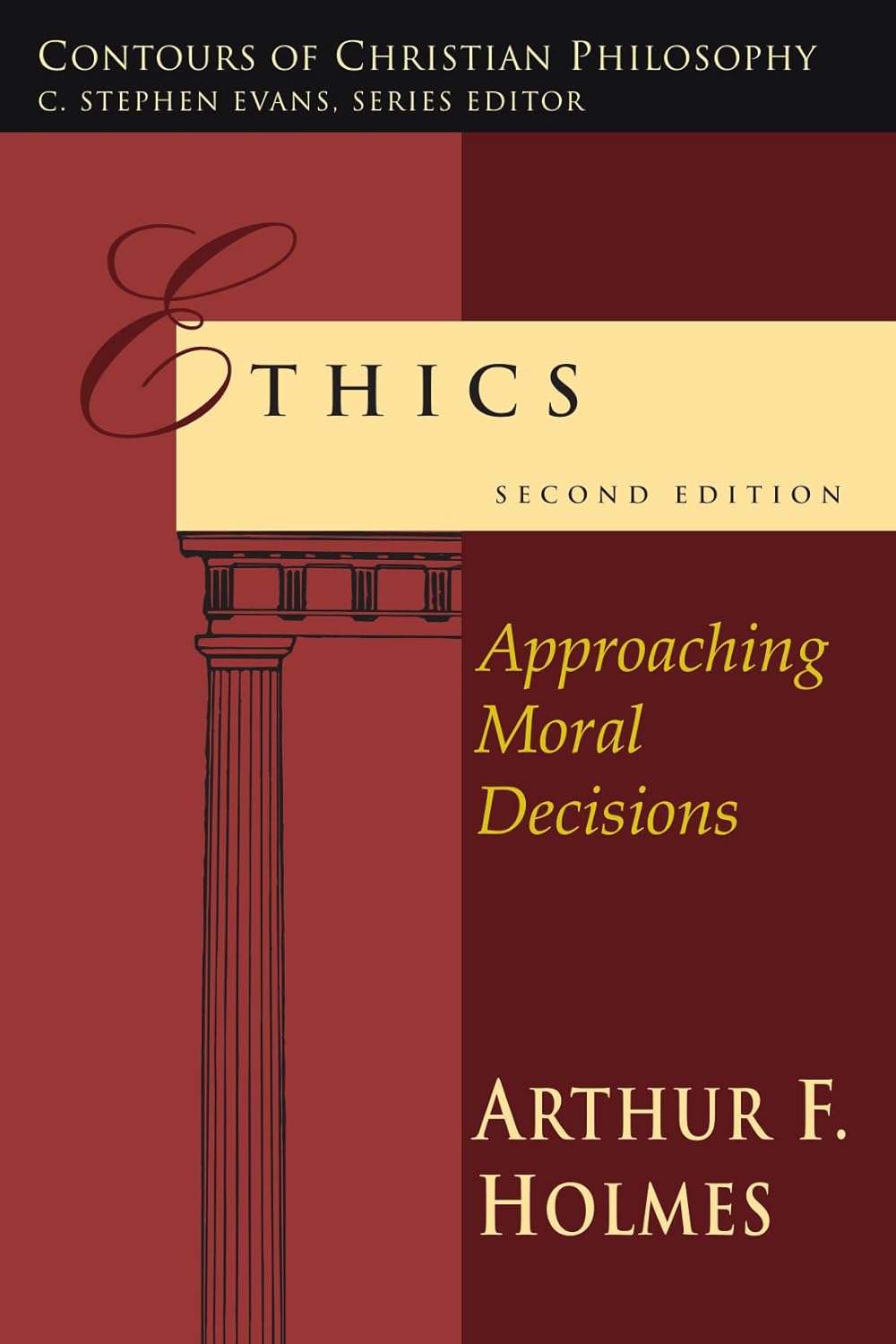
AUTHOR – ARTHUR F. HOLMES
GENRE – Philosophy
YEAR PUBLISHED – 1984
PAGE COUNT – 150
READABILITY – Easy
MY RATING – 4.5/5
What to expect?
- This book is for beginners & an easy read
- Discusses about the moral judgements that we make
- Is morality objective or subjective?
- Do we have rights? Should we strive to achieve any virtue?
- This book is written in a Christian perspective
First published in 1984 & revised in a 2nd edition, it has remained a standard text in Christian liberal arts education for over four decades.
Holmes was Professor of Philosophy at Wheaton College for over forty years & his approach throughout the book is that of a careful teacher who wants his reader to think well rather than simply adopt conclusions. He covers the major ethical theories, examines applied questions & moves toward a constructive Christian ethical framework, all without condescension & without sacrificing philosophical precision for accessibility.
The Moral Revolution & Cultural Relativism
Holmes opens with what he calls the moral revolution that the collapse of inherited moral consensus in Western societies & the resulting uncertainty about whether moral judgments express anything more than personal preference or cultural convention. This opening sets the stakes clearly: if moral relativism is true, ethical reasoning is ultimately pointless. The 2nd chapter examines cultural relativism directly which is the view that moral judgments are valid only relative to the culture that produces them. Holmes gives the strongest version of this position its due before identifying its fatal weaknesses, particularly its inability to account for genuine moral progress or cross cultural moral criticism.
Emotivist Ethics & Ethical Egoism
Chapters 3 & 4 address two further attempts to reduce moral judgment to something less than objective truth. Emotivism is the view associated with A.J. Ayer & Charles Stevenson that moral statements express emotional attitudes rather than making factual claims that is presented clearly & examined carefully. Holmes acknowledges its insight into the motivational dimension of moral language while showing that it cannot account for the rational structure of moral argument. Ethical egoism is the view that each person ought to pursue their own self interest that receives similar treatment: clearly stated, genuinely engaged & ultimately found wanting both on philosophical grounds & in terms of its implications for social life.
Utilitarianism
Chapter 5 gives utilitarianism that the most influential of all modern ethical theories. Holmes traces the theory from Bentham through John Stuart Mill, distinguishes act from utilitarianism & examines the serious objections that both versions face. The problem of justice is that utilitarianism seems in principle to permit serious injustices to individuals if they produce sufficient aggregate benefit that receives particular attention. Holmes is fair to the theory’s genuine strengths while being clear about the points at which it fails to capture what morality actually requires.
Toward a Christian Ethic & Moral Knowledge
Chapters 6 & 7 mark the transition from critical survey to constructive proposal. Holmes argues that a fully adequate ethics requires a metaphysical foundation that secular theories cannot provide i.e specifically, an account of human nature & human dignity grounded in the conviction that human beings are created in the image of God. This is not an appeal to religious authority over philosophical argument but a claim that philosophical ethics itself, pursued rigorously points toward questions that only a theistic framework can adequately answer. Chapter 7 examines moral knowledge & how we come to know moral truths, the role of conscience, moral intuition & reason as why moral knowledge is possible at all.
The Basis of Obligation & Human Rights
Chapters 8 & 9 address two of the most fundamental questions in ethical theory. What is the basis of moral obligation? Why are we bound by moral requirements at all? Holmes examines deontological approaches (particularly Kantian ethics) alongside the divine command tradition, arguing that moral obligation is ultimately grounded in the character of God & the nature of human beings as His image bearers. The chapter on human rights connects this metaphysical foundation to contemporary moral & political discourse, arguing that the language of rights is so pervasive in modern culture that it requires exactly the kind of grounding that secular liberalism struggles to provide.
Applied Ethics: Punishment, Legislation, Sex & Marriage
Chapters 10 through 12 move into applied territory. Criminal punishment with its justification, its aims & the competing theories of retribution. The question of whether morality can or should be legislated receives careful treatment, navigating between the view that law & morality are entirely separate from the theocratic position that law should simply enforce religious morality. The chapter on sex & marriage addresses one of the most contested areas of contemporary moral debate, examining the philosophical & theological foundations of traditional sexual ethics without either dismissiveness or special pleading.
The Moral Agent & Virtue Ethics
The final two substantive chapters bring the book full circle. Chapter 13 examines the moral agent that the person who makes moral decisions with attention to the role of motivation, intention, character & moral development. Chapter 14 addresses virtue ethics directly, recovering the Aristotelian insight that ethics is fundamentally about the formation of character rather than the application of rules or the calculation of consequences. Holmes presents virtue ethics not as an alternative to obligation based ethics but as its necessary complement of what moral rules require if a person of sufficient character is to apply them wisely & consistently.
Final Assessment
Ethics: Approaching Moral Decisions achieves something genuinely difficult & a comprehensive survey of ethical theory that is simultaneously philosophically reliable, practically engaged & intellectually honest about its own commitments. Holmes never pretends to a neutrality he does not have but his engagement with opposing positions is consistently fair & his arguments carefully made. For readers approaching ethics seriously for the first time, or returning to it with fresh questions, it remains one of the most trustworthy guides available & as a book that teaches its reader not just what to think about morality but how to think about it.