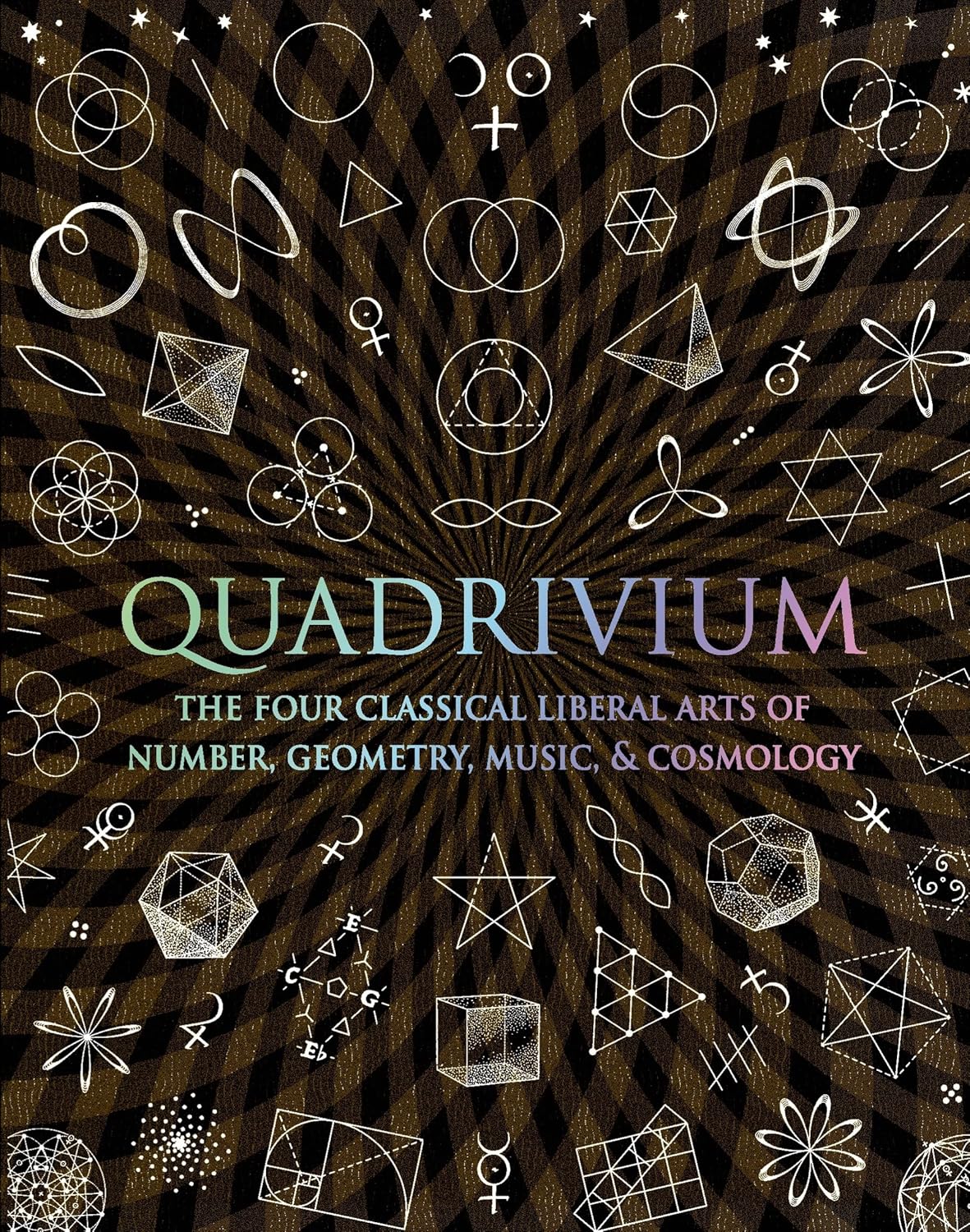
QUADRIVIUM
AUTHOR – Multiple Authors
GENRE – Philosophy & Mathematics
YEAR PUBLISHED – 2010
PAGE COUNT – 409
READABILITY – Intermediate
MY RATING – 4.8/5
What to expect?
- This is the older science & called as 4 classical liberal arts
- Harmonics, Astrology, Numerology are discussed here
- This book reveals the grand design of the universe & why
- Very much illustrated with all details
Somewhere in the middle of Quadrivium, the reader realizes that what they are holding is not quite like any other book they have encountered. It is not a textbook, not a coffee table book, not a work of popular science & not quite a work of philosophy & yet it is all of these things simultaneously. Published by Wooden Books in 2010 & compiled by John Martineau from five individual volumes in the Wooden Books series, Quadrivium gathers in one place the four disciplines that formed the upper tier of the classical medieval curriculum: Number, Geometry, Music & Cosmology. In doing so it recovers something that modern education has almost entirely lost i.e the idea that these four disciplines are not separate subjects but four faces of a single reality & that understanding them together is the beginning of understanding the nature of things.
What the Quadrivium Is & Why It Matters
“The Quadrivium” from the Latin meaning four ways or four roads was one half of the classical seven liberal arts. The lower three, the Trivium, covered Grammar, Logic & Rhetoric: The arts of language & thought. The upper four are Arithmetic, Geometry, Music & Astronomy covered number in its various manifestations: number in itself, number in space, number in time & number in space & time together. This curriculum was not invented by the medieval universities. It was inherited from the ancient world, from Plato’s Academy & before that from the Pythagoreans, who held that number was not merely a tool of calculation but the deep structure of reality itself.
Boethius, writing in the 6th century formalized the Quadrivium for the Latin West & transmitted it to the medieval world. For over a thousand years, educated Europeans were trained to see mathematics not as a purely technical discipline but as a philosophical & even theological one, a pathway toward understanding the order embedded in creation. Quadrivium the book is, at its deepest level is an attempt to recover this vision for the modern reader.
Number: The Foundation
Miranda Lundy’s opening section on number establishes the philosophical framework on which everything else rests. The Pythagorean & Platonic tradition did not regard numbers as abstractions invented by the human mind for practical convenience. Numbers were understood as real in some accounts than the physical things that merely instantiated them. The number one, the Monad, was not simply the first counting number but a symbol of unity, wholeness & the undivided ground of being from which all multiplicity proceeds. Two introduces distinction & relationship. Three introduces resolution & harmony. The progression through the first ten numbers given extended visual & philosophical treatment here was understood as a map of the fundamental principles through which reality articulates itself.
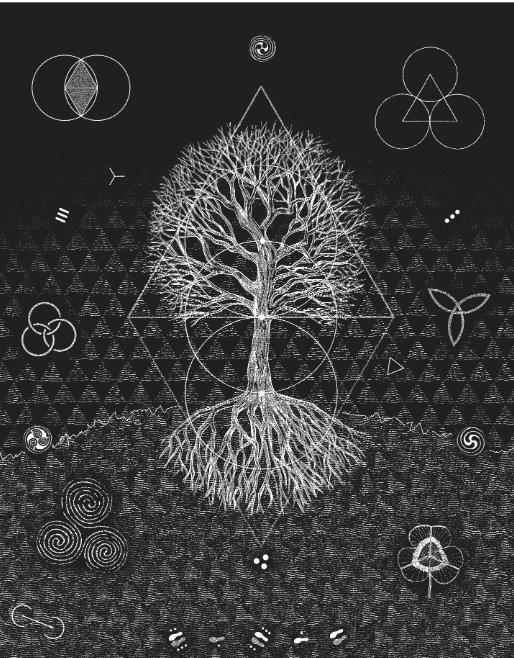
The properties of numbers whether odd & even, prime & composite, perfect & deficient are presented not merely as arithmetical facts but as characteristics with philosophical significance. This is not numerology in the popular debased sense. It is the recovery of a tradition in which mathematics & metaphysics were understood as inseparable.
Geometry: Number in Space
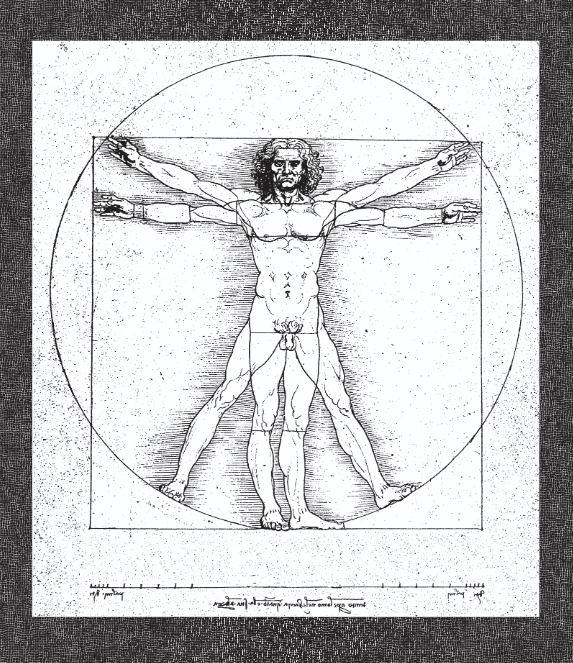
Daud Sutton’s section on geometry is visually the most stunning in the book & philosophically the most immediately accessible. Sacred geometry is the study of the geometric proportions & patterns that recur across nature, art & architecture is presented here with both mathematical precision & genuine aesthetic force. The Platonic solids, the five regular polyhedra whose faces are identical regular polygons, receive detailed treatment. Plato, in the Timaeus associated these five solids with the five elements which are earth, water, fire, air & the cosmos itself. The tradition that followed him found in their mathematical properties evidence of a rational order underlying physical reality.
Music: Number in Time
The Pythagorean discovery that musical consonance corresponds to simple numerical ratios i.e the octave to 2:1, the perfect fifth to 3:2, the perfect fourth to 4:3 which was experienced by the ancient world not merely as an interesting fact but as a revelation about the nature of reality. If the most beautiful relationships in sound are governed by the simplest numerical ratios, then beauty & mathematical order are not separate things. Harmony is not a subjective aesthetic preference. It is an objective property of the numerical relationships themselves.
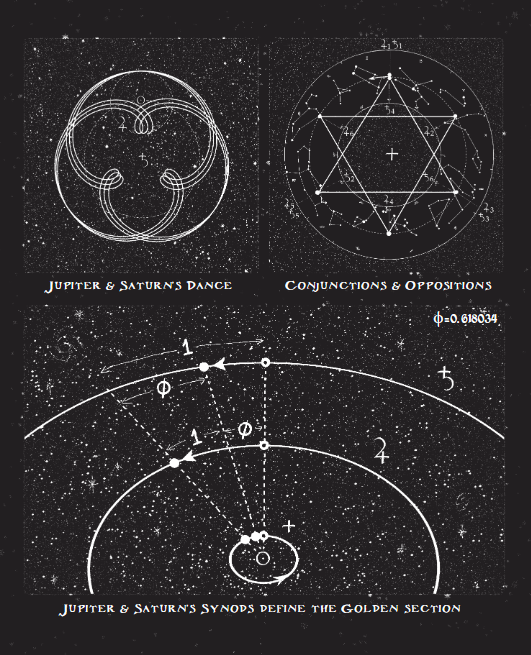
This insight developed by Boethius into the doctrine of the music of the spheres, the idea that the orbital relationships of the planets replicate the same harmonic ratios found in music sounds exaggerated to the modern ear. It is a serious philosophical hypothesis about the unity of mathematical order across different domains of reality. Whether one ultimately accepts or rejects it, the hypothesis is more coherent & more interesting than most modern dismissals of it suggest.
Cosmology: Number in Space & Time
The final section on cosmology brings the preceding three disciplines together into a unified vision of the ordered cosmos. From Pythagorean & Platonic cosmology through medieval astronomical models to the modern scientific picture of the universe, the thread that runs through all of them is the conviction sometimes explicit, sometimes implicit that the universe is not a random collection of matter & energy but a rationally ordered whole whose structure is mathematical in character. The modern cosmological discovery that the laws of physics are mathematical that the universe is, in the physicist Eugene Wigner’s famous phrase, characterized by the unreasonable effectiveness of mathematics is presented here not as a modern surprise but as the confirmation of what the Pythagorean & Platonic tradition had always maintained.
Conclusion
Quadrivium is a book that asks its reader to slow down. Its pages are dense with diagrams, proportions & visual demonstrations that reward extended attention rather than rapid reading. What the book ultimately offers is not merely information but a vision. The vision of a cosmos that is rationally ordered, mathematically structured & beautiful in a way that is not accidental but intrinsic. Whether that vision is ultimately philosophical, theological or simply aesthetic is a question Quadrivium wisely leaves open. What it does not leave open is whether the vision is worth taking seriously.