THE UNSEEN REALM
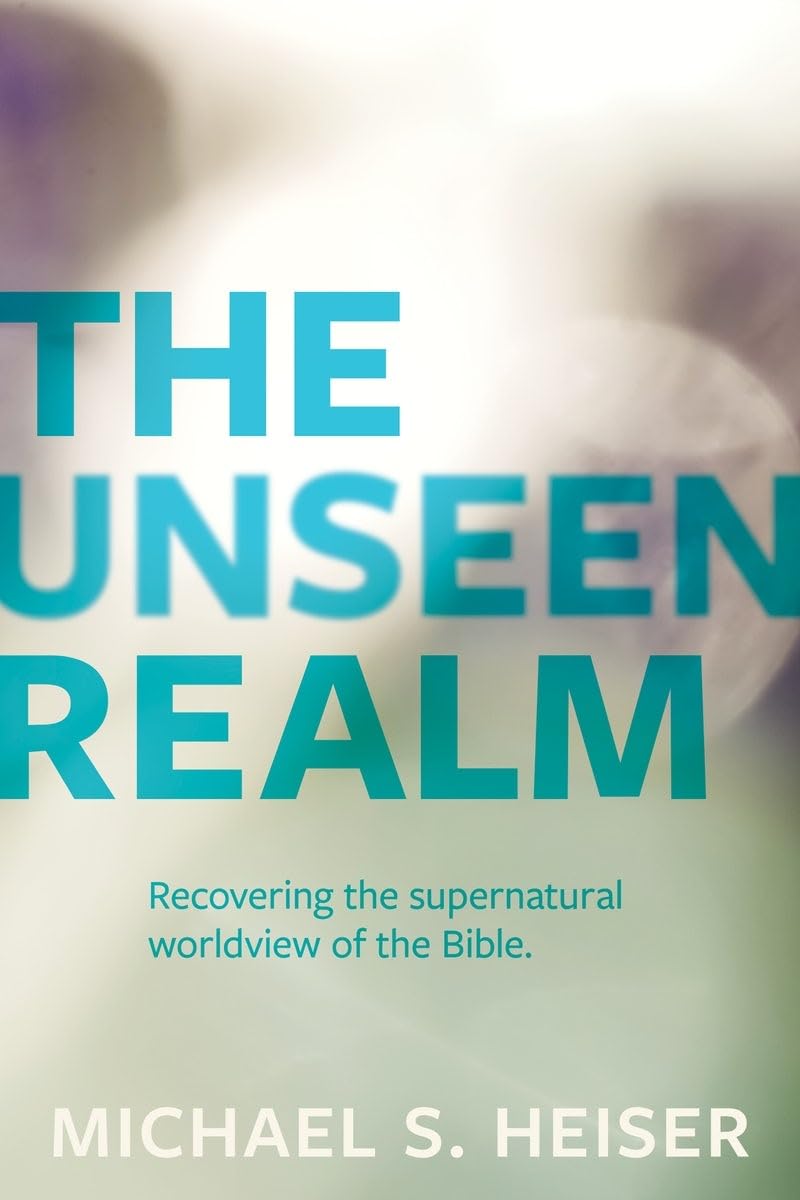
AUTHOR – Dr. MICHAEL S.HEISER
GENRE – Christian Theology
YEAR PUBLISHED – 2015
PAGE COUNT – 416
READABILITY – Easy/Moderate
MY RATING – 4.5/5
What to expect?
- Divine Council
- Origin of Nephilim
- How did all other religions surrounding Israel form?
- Human Free will & God’s foreknowledge
- The Trinitarian view in Old Testament
- Who is the Angel of the Lord?
If you’ve ever read the Bible and glossed over passages like Psalm 82, Genesis 6 or Deuteronomy 32:8 without quite knowing what to do with them then this book is for you. The Unseen Realm is Dr. Michael Heiser’s attempt to recover what he calls the “ancient Israelite worldview” embedded in Scripture, a framework that modern Christianity has largely lost or quietly ignored.
The Divine Council: God Was Never Alone
The book’s central thesis is that the Bible, read in its original ancient Near Eastern context, presents a heavenly court (“divine council”) of supernatural beings who operate under Yahweh’s authority. Heiser anchors this primarily in Psalm 82, where God (Elohim) addresses a group also called elohim, pronouncing judgment on them for corrupt rule over the nations. His argument is sharp: the word Elohim is not exclusive to Israel’s God. It refers to any being who inhabits the spiritual realm & Yahweh, while uniquely supreme, presides over a structured hierarchy of lesser divine beings what the Bible also calls Sons of God, Watchers, cherubim & heavenly hosts.
This is not sensationalism btw. Heiser walks carefully through Hebrew linguistics, the Dead Sea Scrolls (particularly the corrected reading of Deuteronomy 32:8 “sons of God” rather than “sons of Israel”) & comparative texts from Ugarit, Israel’s northern neighbor, to show that these ideas were not isolated & they were foundational to how biblical writers understood the cosmos.
The Big Turning Points: Eden, Babel & Beyond
Heiser structures much of the book around four key cosmic events: Garden of Eden, the Flood (and the Sons of God episode in Genesis 6), the Tower of Babel & Sinai. When the nations are scattered at Babel (Genesis 11), Heiser connects this to Deuteronomy 32:8-9 arguing that Yahweh disinherited the nations, handing them over to lesser divine beings, while keeping Israel as his own inheritance. This is the backdrop, he argues for Paul’s statements in Acts 17 and Ephesians 3. The mission of the church is a cosmic reclamation project, undoing what happened at Babel, bringing the nations back under Yahweh.
The Two Yahweh Problem
One of the most provocative sections deals with the Angel of the Lord which is the figure who appears to Abraham, Moses, Gideon & Joshua & who is simultaneously distinguished from Yahweh and identified as Yahweh. The biblical writers intentionally “blur” two figures as an invisible God and a visible, human form manifestation of God as a deliberate theological statement. He traces this through Genesis, Exodus, Judges & into the New Testament, arguing that early Judaism itself once accepted the concept of “two powers in heaven” (citing scholars like Alan Segal and Daniel Boyarin), a view suppressed only after the rise of Christianity. (I have reviewed Alan Segal’s book as well)
Foreknowledge vs Predestination
In a section that will resonate with anyone who has wrestled with Calvinist/Arminian debates, Heiser uses 1 Samuel 23 to drive a careful wedge between divine foreknowledge & predestination. God tells David that Saul will come and that the people of Keilah will hand him over and then neither event happens. Heiser’s point: God can foreknow a contingent possibility without predestining it. The Fall was not scripted; it was foreknown. God had a plan ready but he did not engineer the evil. This is crucial in understanding the Free will which also allows God’s sovereignty.
Nephilim, Giants & the Cosmic War
The later sections on the Nephilim and the giant clans (Anakim, Rephaim, Emim, Zamzummim) are the parts most likely to raise eyebrows or delighted recognition, depending on your background. Heiser reads Genesis 6:1-4 as a literal intrusion of rebellious divine beings into the human bloodline, producing a corrupted offspring. He traces these giant clans through Numbers, Deuteronomy, Joshua & the books of Samuel, culminating in David’s campaigns against the Philistine giants like Goliath of Gath being the most famous. The conquest of Canaan, in this reading, takes on an entirely different weight: it was not merely political but cosmic, a deliberate wiping out of a corrupted lineage.
Conclusion
The Unseen Realm is not light reading. It asks you to sit with Hebrew vocabulary, ancient Semitic cosmology & intertextual connections across dozens of books of the Bible. But Heiser is a patient guide & his central point lands with force: the Bible has an internally consistent supernatural worldview that most modern readers churchgoers and skeptics alike have never been taught to see. Whether you end up fully persuaded or not, this book will change the way you read passages you thought you already understood. And that alone makes it worth the effort. I personally would add more weightage to Heiser’s view as this is the Orthodox paradigm as well.