TWO POWERS IN HEAVEN
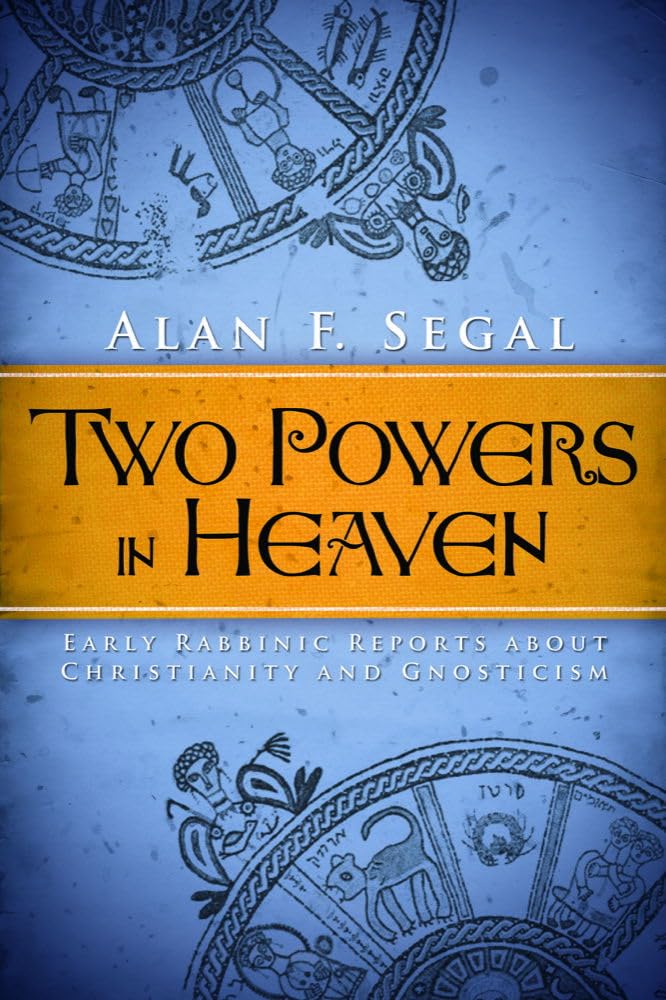
AUTHOR – ALAN F. SEGAL
GENRE – Christian/Jewish theology
YEAR PUBLISHED – 2012
PAGE COUNT – 313
READABILITY- Moderate/Hard
MY RATING – 4.8/5
What to expect?
- The Jewish idea of a 2 divine powers in Heaven
- Early Church Fathers about 2 powers in Heaven
- Early Rabbanic Evidence of this sect
- Why was this view considered heresy by later Jews
There are books that tidy up what you thought you knew & then there are books that quietly dismantle it. Alan F. Segal’s Two Powers in Heaven is firmly in the second category. This traces a largely forgotten debate within early Judaism where one has enormous implications for how we understand the origins of both Christianity & rabbinic orthodoxy.
What the Book Is Actually About
The central argument is simple: there existed within ancient Judaism, a widespread tradition that posited a second divine figure alongside God. Not an evil counterpart, no Persian style dualism here but an exalted being, A principal angel & this figure sometimes called the logos, sometimes the Angel of YHWH, sometimes the “son of man” The rabbis eventually labeled belief in this figure “two powers in heaven” and declared it heresy. Segal’s question is: why & against whom?
The Rabbinic Evidence
Segal opens with the rabbinic texts themselves which is the Mekhilta, the Talmud, Mishnah Sanhedrin & combing through passages where the rabbis go to notable lengths to shut down interpretations that might suggest a second divine being. A recurring flashpoint is Daniel 7:9, where multiple thrones appear in heaven and a “son of man” figure is invested with dominion alongside the Ancient of Days. The rabbis found this passage dangerous enough to construct careful defenses against it. That defensiveness, Segal argues, is itself evidence you don’t build walls around a threat that doesn’t exist.
Other key passages include Genesis 1:26 (“let us make man”), Exodus 23:21 (where an angel carries God’s very name and has authority to forgive sins) & the famous Genesis 19:24 construction where “the Lord rained fire from the Lord” which is a verse that practically invites a two figure reading.
Philo and the Second God
One of the book’s most illuminating sections deals with Philo of Alexandria, who openly uses the term deuteros theos which is a “second God” & to describe the divine logos. Philo was a first century Jewish thinker, not a Christian, yet his framework maps remarkably onto what would later become Christian theology about Jesus Christ. Segal makes the case that Philo was not innovating so much as drawing on a tradition already in circulation where the one that predated both Christianity & the rabbinic movement’s formal opposition to it. This is a significant finding. It means the idea of a second heavenly figure was not smuggled into Judaism by Christians or invented by Gnostics. It was already there embedded in the exegesis of texts like Genesis 31:13 & the theophany passages of Exodus.
The Church Fathers
Segal then turns to Justin Martyr, Theophilus of Antioch, Irenaeus, Tertullian & Origen, showing how each of them in different ways drew on the same scriptural traditions the rabbis were trying to suppress & call as heresy. Justin’s Dialogue with Trypho is particularly revealing: in it a Jewish interlocutor concedes that a second divine figure exists in Scripture only disputing whether that figure is Jesus. The argument was not about whether there were two figures but it was about identity. Origen goes furthest stating plainly that Christianity could speak in one sense, of “two Gods” while insisting on ultimate monotheism. The charge of believing in two gods was one that Christians had to constantly navigate not just from outside but from within their own ranks as modalist & monarchianist Christians pushed back.
Conclusion
What Segal demonstrates, with careful and patient scholarship is that the sharp boundary between Jewish monotheism & Christian “binitarianism” was not always so sharp. For readers who have encountered references to this book in works like Michael Heiser’s The Unseen Realm, this is the primary source. This is dense academic & written for scholars of Second Temple Judaism & early Christianity. But for anyone willing to work through it Two Powers in Heaven offers a rare window into the messy, contested world in which both Judaism and Christianity defined themselves often against each other & often over the same ancient texts.