FABRICATING JESUS
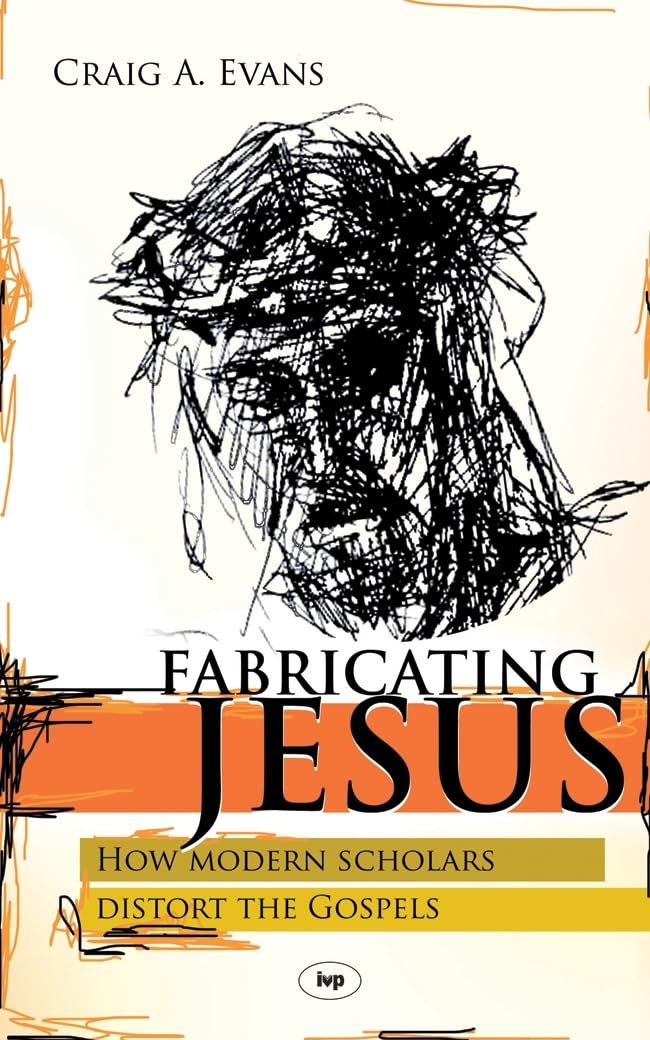
AUTHOR – CRIAG EVANS
GENRE – New Testament Studies
YEAR PUBLISHED – 2007
PAGE COUNT – 290
READABILITY- Easy / Moderate
MY RATING – 4.7/5
What to expect?
- How NT (New Testament) scholarship works?
- How NT scholars are hyper critical about Jesus?
- What kind of evidence do we have for Jesus?
- Is NT reliable?
The Modern Crisis of Historical Jesus Studies
In contemporary biblical scholarship, a profound tension persists between traditional Christian faith & critical historical methodology. Craig A. Evans’s Fabricating Jesus enters this highly polarized environment as a deliberate methodological corrective against what he diagnoses as “hypercriticism” which is a scholarly trend that frequently treats extreme skepticism as a badge of honor. Evans steps into the fray to analyze how specific academic circles & popular culture outlets “fabricate” alternative, unhistorical versions of Jesus by misusing canonical & extracanonical texts. Written from a historical standpoint, the book evaluates the reliability of the New Testament Gospels against the backdrop of ancient texts, textual archaeology & early Christian history.
Presuppositions, Literacy & the Jewish Matrix
A central pillar of Evans’s critique targets the methodology of highly skeptical academic groups, most notably the Jesus Seminar. The Jesus Seminar famously concluded that only approximately 18% of the sayings attributed to Jesus in the New Testament are authentic. Evans argues that such low statistics are not the result of neutral discovery but rather flow from problematic, unproven starting points. Many radical historians operate under the rigid presupposition that Jesus was an illiterate peasant with no formal training, no interest in Jewish Scripture & zero apocalyptic or messianic self-understanding.
To counter the claim of illiteracy, Evans points to a wealth of contextual & literary data. New Testament passages explicitly describe Jesus reading from scrolls or being interrogated on textual matters. More importantly, the cultural landscape of first century Jewish Palestine favored textual engagement. Citing historical directives from the Torah, the Testament of Levi & the historian Josephus, Evans notes that Jewish communities prioritized teaching children the law. Furthermore, the Synoptic Gospels show that Jesus directly quoted or alluded to 23 of the 36 books in the Hebrew Bible. Ranging across the Pentateuch, the major prophets like Isaiah & the minor prophets. This deep scriptural immersion heavily contradicts the portrait of a simple, illiterate peasant.
Realism in Criteria: How Historians Know What is Authentic
Rather than relying on dogmatic assumptions of scripture’s total text inerrancy which Evans warns can cause a collapse of faith when minute discrepancies are found, he embraces standardized historical criteria to evaluate the canonical texts. He highlights that the core of the Christian message historically hinges upon the reality of the resurrection, rather than our modern capability to neatly harmonize every minute detail among the four accounts. To separate historical fact from later myth, Evans leverages specific criteria:
- Multiple Attestation: Sayings or deeds that appear across independent textual streams (such as the Gospel of Mark & the hypothetical “Q” source used by Matthew & Luke) imply wide, early circulation rather than individual fabrication.
- Embarrassment: The early Church would never invent details that complicated their theological message. The baptism of a sinless Jesus by John or John the Baptist openly expressing doubt about Jesus’s identity while in prison serve as key historical anchors precisely because they caused narrative discomfort to the early writers.
- Semitic & Palestinian Background: Authentic components inevitably retain traces of Hebrew or Aramaic syntax & demonstrate an accurate, complex familiarity with first century Palestinian customs.
Through these criteria, Evans refutes the popular thesis that Jesus was simply a Mediterranean “Cynic” philosopher or a wanderer seeking individualistic happiness in accordance with nature. He demonstrates that Jesus’s actual teachings on nature were always distinctly theological, illustrating a generous Creator, while urging his followers to actively repent & seek the imminent eschatological rule of God.
Dismantling the Apocryphal Claims
The secondary focus of Fabricating Jesus deals with the sudden popularity of extracanonical & Gnostic writings. Evans categorizes texts like the Gospel of Thomas, the Gospel of Mary, the Gospel of Peter & the Egerton Gospel chronologically to underscore their secondary nature. While canonical works like Mark date from roughly 60–70 AD, the vast majority of apocryphal texts did not emerge until mid to late second century which is 50 to 80 years later.
Evans systematically deconstructs these texts to show they are textually dependent on a “collage” of the canonical works rather than representing early, independent memory. For example, the Gospel of Thomas is saturated with distinctive Gnostic theological views: the physical world is treated as an inherently evil prison created by an inferior god & salvation is achieved not through faith or the pardoning of sins but through private, esoteric gnosis (knowledge).
Similarly, Evans dismisses the historical worth of the Gospel of Peter, pointing out that its author describes Jewish elders camping out inside a cemetery overnight to guard Jesus’s tomb which is an action that completely displays an unhistorical ignorance of strict Jewish laws regarding corpse impurity. He also addresses the sensationalist Secret Gospel of Mark, validating the widespread consensus that it was an elaborate mid 20th century hoax forged by its discoverer, Morton Smith. Finally, he addresses the Gospel of Judas, tracing its lineage back to the heretical Cainites described by Irenaeus in AD 180, showing it reverses biblical roles to make a hero out of a villain, offering zero authentic data regarding the historical Judas.
Conclusion
Ultimately, Craig Evans presents a structured, evidence driven argument that aims to demystify radical historical revisionism. By placing Jesus firmly within his first century Jewish, scriptural & Palestinian reality. Evans illustrates that the extracanonical alternative gospels tell us a great deal about the evolving theological battles of the second & third centuries but virtually nothing about the historical Jesus of Nazareth. For the student of history, the book serves as an important warning against allowing modern cultural trends to rewrite ancient records.